Honeybees and ants look nothing alike, yet they share a surprising amount. Both live in highly organised colonies, both communicate in ways that seem almost like a language, and both have a large effect on the ecosystems around them. They are also easy to misunderstand. Ant colonies are not run by a queen who gives orders, and bees are not the only insects that pollinate crops. This article collects some of the most interesting and best-supported facts about both groups, along with a few common myths to retire.
The goal is accuracy over trivia. Where precise numbers are disputed or vary by species, the article says so instead of quoting a neat figure that cannot be backed up.
Key takeaways
- Bees and ants belong to the same large insect group, the Hymenoptera, which also includes wasps. Ants are close relatives of bees, but they are not the same.
- Honeybees use a "waggle dance" to share information about the direction and distance of food. The details of how distance is encoded are still being studied.
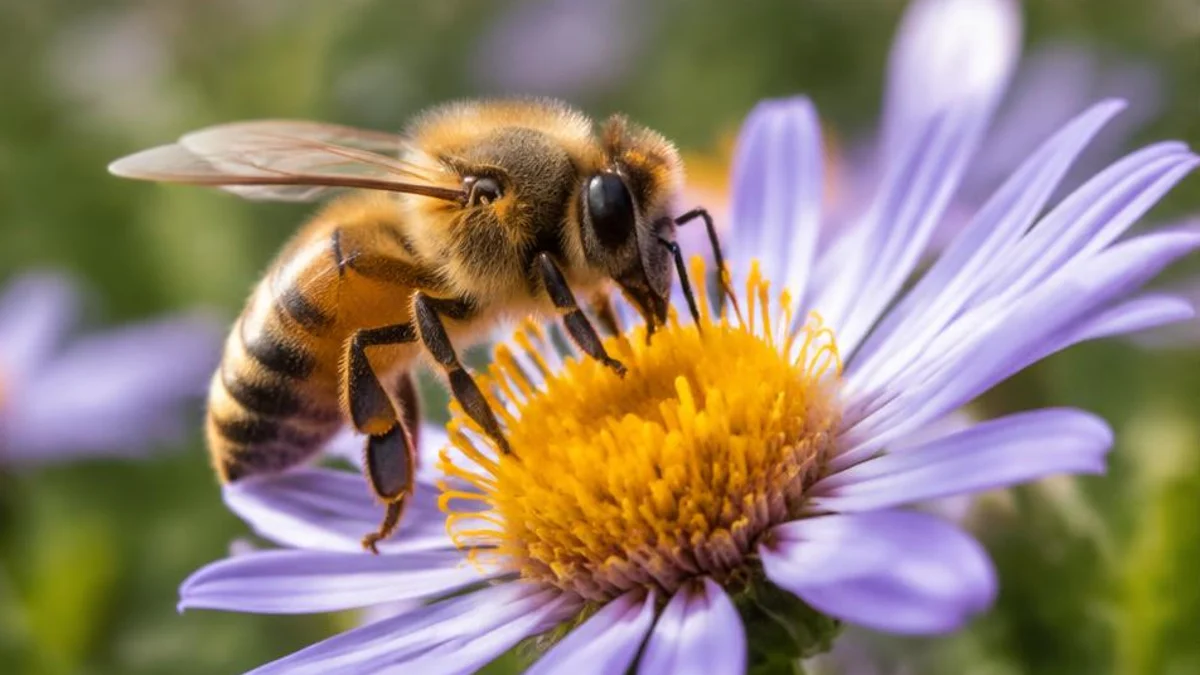
- Honeybees collect nectar and pollen for different purposes. Nectar is mainly an energy source, and pollen is a source of protein and other nutrients.
- Bees are important pollinators, but not every crop depends on them, and many other animals pollinate too.
- Ant colonies work through decentralised signals, such as chemical trails, not through commands from a queen.
- Ant species vary enormously, and not all follow the same fixed division of labour.
- Leaf-cutter ants do not eat leaves directly. They use them to grow a fungus that they feed on.
Cousins in the same insect order
Bees, wasps and ants are all members of an order of insects called the Hymenoptera. That makes ants relatives of bees, in the sense that they share a common ancestor in the distant past, but it does not make them the same kind of animal. Ants form their own large family, and bees belong to others. Many ants are descended from wasp-like ancestors, which is part of why scientists describe all three groups as related.
Both bees and ants include species that live in large social groups. Biologists use the term eusocial for animals with a particular combination of traits: cooperative care of young, overlapping generations in a colony, and a division of reproductive labour in which some individuals reproduce and others mainly do not. Honeybees and many ants fit this description, though many other bee and ant species live differently.
The honeybee colony
A honeybee colony typically has three kinds of members:
- A single queen, who lays the eggs.
- Many female workers, who forage, build comb, care for the young, guard the entrance and carry out other tasks.
- Male drones, whose main role is to mate with queens from other colonies.
The queen is not a ruler in the human sense. She does not direct the colony's activities. Colony behaviour emerges from the combined actions of thousands of workers responding to signals such as chemicals, temperature, food supply and the needs of the brood.
The waggle dance
One of the best-known discoveries about honeybees is that a forager that has found a good source of food can tell nestmates where it is. The forager returns to the hive and performs a figure-of-eight movement known as the waggle dance. The straight central part of the dance, where the bee waggles its body, carries the information:
- The angle of the waggle run, measured against the vertical surface of the comb, indicates the direction of the food source relative to the sun.
- The length of the waggle is related to how far away the food is: a longer waggle generally signals a greater distance.
The Austrian scientist Karl von Frisch described this system in the twentieth century and later shared a Nobel Prize partly for his work on bee communication. Researchers continue to test the details. For example, studies have examined exactly how waggle duration maps onto distance, and the answer can depend on factors such as terrain and the species of bee. So the safest statement is that the dance conveys direction and distance, with the finer points still under investigation.
It is also worth noting that not all honeybee species use the dance in the same way, and many other bees do not dance at all.
Nectar and pollen are not the same
People often use "pollen" and "nectar" interchangeably, but for bees they have different jobs:
- Nectar is a sugary liquid produced by flowers. Bees collect it as an energy source, and honeybees turn it into honey for storage.
- Pollen is made of tiny grains produced by flowers' male parts. Bees collect it as food rich in protein and other nutrients, which is especially important for raising young bees.
As bees move between flowers collecting these resources, some pollen sticks to their bodies and gets transferred to other flowers. That is how they pollinate. For a closer look at the honey side of the story, see our article on how bees make honey.
Are bees responsible for all our food?
Honeybees and wild bees are important pollinators, but it is an overstatement to say all food depends on them. Many crops do benefit from insect pollination, including numerous fruits, vegetables, nuts and seeds. However, major staple crops such as wheat, rice and maize are mostly pollinated by wind or are self-pollinating. And bees are not the only pollinators: flies, butterflies, moths, beetles, birds and bats also play a role, depending on the plant and the region.
The accurate summary is that bees are very important to many crops and wild plants, and protecting pollinators of all kinds is valuable, without claiming that nothing would grow without honeybees.
How ants organise without a boss
It is easy to imagine an ant colony as a tiny kingdom where the queen gives orders. In reality, an ant queen's main role in most species is to lay eggs. The colony's day-to-day decisions are made through decentralised signals passed between individual ants.
The best-known signal is the pheromone trail. A forager that finds food can lay a chemical trail on its way back to the nest. Other ants that detect the trail are more likely to follow it, and if they find food too, they reinforce it. Trails to good sources become stronger, while trails that lead nowhere fade as the chemical evaporates. No single ant plans the route, yet the colony as a whole tends to settle on efficient paths. Researchers study this kind of collective behaviour because it shows how simple rules followed by many individuals can produce intelligent-looking results.
Not every ant has a fixed job
Popular accounts often describe ants as having rigid roles, such as soldier, forager or nurse. Ants do show division of labour, and in some species workers come in different sizes and shapes suited to different tasks. But the details vary enormously across the thousands of ant species. In some, workers change tasks as they age or as the colony's needs change. In others, roles are more flexible than the textbook picture suggests. It is better to treat "ants have fixed jobs" as a generalisation with many exceptions.
Ants that farm
Some of the most remarkable ants are the leaf-cutter ants of the Americas. They cut pieces of leaves and carry them back to the nest. A common misunderstanding is that they eat the leaves. In fact, they use the leaf fragments as a substrate on which to grow a fungus, and the fungus is the food source for the colony. Smithsonian science resources describe this as a form of agriculture, with the ants cultivating, tending and protecting their crop, and scientists use the group to study how cooperation and farming evolved in nature.
Not every ant species farms fungus, and the comparison with human agriculture is an analogy. Still, it shows how complex some insect societies can be.
Watching them safely and kindly
Both bees and ants are fascinating to observe, and a few common-sense habits keep it safe and respectful:
- Watch from a distance. Do not poke nests or hives, and do not try to handle bees.
- Do not disturb a hive or swarm. If bees are in a place where they cause concern, contact a local beekeeper or the appropriate service.
- Take allergies seriously. Stings can be dangerous for people with allergies, and anyone who has a severe reaction needs medical help.
- Avoid casual use of baits and pesticides, which can harm non-target species. If ants are a household problem, look for guidance from reputable pest-control or extension services in your area.
- Support wild habitat. Planting a variety of flowers and leaving some undisturbed ground can help many insects.
Frequently asked questions
Are ants related to bees?
Yes, they are relatives within the order Hymenoptera, which also includes wasps. They are not the same kind of insect, though.
What is the waggle dance?
It is a figure-of-eight movement used by honeybee foragers to tell nestmates the direction and approximate distance of food. Scientists are still refining the details.
Does the ant queen give orders?
In most species, no. The queen mainly lays eggs, and the colony's behaviour emerges from signals such as pheromone trails passed between workers.
Do leaf-cutter ants eat leaves?
Not directly. They use leaf fragments to grow a fungus, and the fungus is their food.
Do all crops need bees?
No. Many crops benefit from insect pollination, but staples such as wheat, rice and maize are mostly wind-pollinated or self-pollinating, and many other animals pollinate too.
Sources and further reading
- Honey bees communicate distance via non-linear waggle duration functions (PubMed Central)
- Ants: social insects and farmers (Smithsonian National Museum of Natural History)
Related reading on FactNest: How bees make honey and How plants communicate with each other.

Written by
FactNest Editorial Team
FactNest is operated by Muonix. The FactNest Editorial Team publishes general-interest explainers with AI-assisted drafting and illustrations. Contact contact@muonix.co for questions or corrections; we respond within 2 business days.
More from this author →