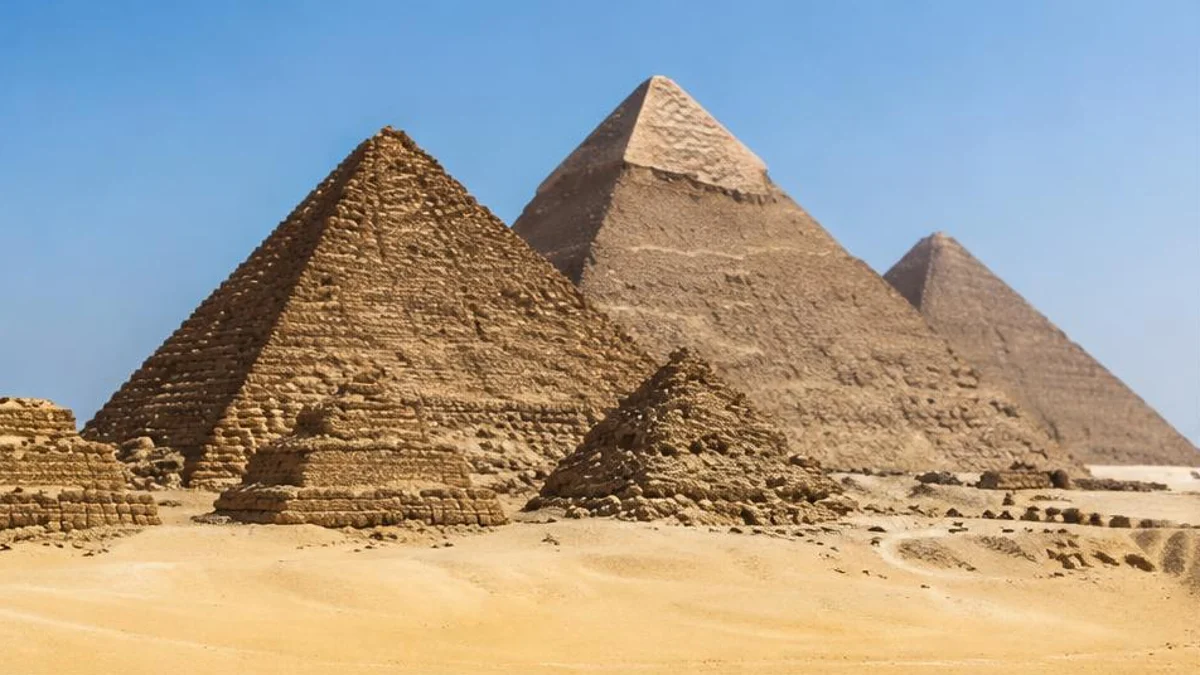
The Great Pyramid of Giza is one of the most studied buildings on Earth, and it still prompts one of the most common questions in history: how did people build something so enormous more than four thousand years ago? The honest answer has two parts. A lot is known, from the quarries, the tools, the workers' settlements and even a surviving logbook. And some questions, especially about the exact shape of the construction ramps, remain open. Separating the evidence from the speculation is the best way to understand the achievement.
This article sticks to what archaeologists and Egyptologists have reported and flags where experts disagree. It does not rely on claims of lost technologies or outside help, because the evidence points firmly to human ingenuity and organisation.
Key takeaways
- The three main pyramids at Giza were built in Egypt's Old Kingdom, during the Fourth Dynasty, around the 26th century BCE, for the kings Khufu, Khafre and Menkaure.
- Most of the stone came from local limestone quarried at or near the site. Finer white limestone for the outer casing came from Tura, across the Nile, and granite came from Aswan, far to the south.
- The Nile was central to moving materials. Boats carried stone for much of the journey.
- Archaeological finds near Giza point to organised, fed and housed work crews and skilled specialists, not a vast mass of enslaved people as popular films suggest, though the exact working conditions are still debated.
- Copper tools, stone tools, sledges, ropes, leverage and ramps are all well supported as methods. The exact ramp design is debated, and no single theory is settled.
- The pyramids were built in phases and differ in size and design.
Who built them and when
The Great Pyramid was built for the pharaoh Khufu, and the two other main pyramids at Giza were built for his successors Khafre and Menkaure. They belong to the Fourth Dynasty of the Old Kingdom, which is generally dated to about the 26th century BCE. Exact dates vary slightly in different chronologies, so it is safest to say "around 2600 to 2500 BCE."
These monuments were the end point of a long development in royal tombs. Earlier kings had been buried in simpler structures, and pyramid design evolved over several generations before reaching the large, smooth-sided form seen at Giza.
Where the stone came from
A pyramid is, above all, a huge pile of carefully cut stone. Different kinds came from different places:
- Local limestone: the core blocks were largely quarried from the Giza plateau itself, close to where they were used. This greatly reduced the distance the heaviest bulk had to travel.
- Fine white limestone from Tura: used for the smooth outer casing. The Tura quarries are on the opposite side of the Nile, and the stone was brought by boat.
- Granite from Aswan: used for special elements such as chamber beams. Aswan lies hundreds of kilometres to the south, so this stone was shipped a long way down the river.
Most of the original casing stones have since been removed over the centuries, which is why the pyramids look rougher today than when they were new.
The river as a highway
The Nile was the main route for moving heavy materials. During the annual flood, water levels rose and boats could get much closer to the building site. Ancient Egyptians built substantial wooden boats, and archaeologists have found evidence of harbours and canals linked to the Giza area.
One of the most exciting finds came from Wadi al-Jarf, on the Red Sea coast, where papyri were discovered that include the logbook of an official named Merer. It records the activities of a work crew transporting limestone from Tura to Giza by boat, during the reign of Khufu. Because it is a record from the time, it is valuable evidence of how stone was transported and organised. Scholars interpret details of it carefully, but it supports the view that river transport and administration were central to the project.
Tools and techniques
The builders did not have iron tools or wheeled cranes. The evidence points to a toolkit of:
- Copper tools such as chisels and saws, often used with abrasive sand to cut stone.
- Stone tools, including hard stone pounders used to shape and break rock.
- Wooden sledges and ropes to drag blocks over prepared surfaces. Workers may have wetted the sand in front of a sledge to reduce friction, an idea supported by an Egyptian wall painting and by modern experiments.
- Levers and wedges to move and position stones.
None of these methods seems miraculous on its own. The achievement lay in combining them with careful planning, measurement and management at a very large scale.
Ramps: what is known and what is debated
To lift blocks to higher levels, the builders almost certainly used ramps of some kind. Traces of ramps have been found at ancient quarries and construction sites in Egypt, so the basic idea is well supported. What is not settled is the exact form of the ramps used at Giza. Proposals include:
- A long straight ramp leaning against one face.
- Ramps that zigzag up the sides.
- A ramp that wraps around the pyramid.
- Interior ramps or a combination of methods.
Each proposal has strengths and difficulties, and researchers continue to test them. Because the ramps were temporary and later removed, direct evidence is limited. It is more accurate to say that ramps and levers were used, and that the details are unresolved, than to claim one definitive answer.
Who were the workers?
Popular imagery often shows thousands of enslaved people forced to haul stones under the whip. The archaeological evidence suggests a different picture. Excavations near the pyramids have uncovered a large settlement with bakeries, breweries, storage areas and housing, as well as cemeteries where workers were buried close to the royal monuments with care. These finds suggest that the labour force was organised, fed and supported by the state.
Researchers believe that a core group of skilled, permanent workers was supported by seasonal labourers, possibly rotating in teams. How these workers were recruited, what obligations they had and how much choice they had remain debated. It would be wrong to claim that everyone was a freely paid volunteer, and equally wrong to assume the Hollywood version. The evidence supports organised labour, skilled specialists and heavy state involvement, with open questions about compulsion.
Not one pyramid, but many
It is easy to talk about "the pyramid" as if there were only one design. In fact, the monuments at Giza were built at different times, with different dimensions and internal layouts. The Great Pyramid is the largest, but the neighbouring pyramids and the smaller satellite pyramids for queens show that plans varied and were adapted as construction went on. The surrounding complex also included temples, causeways and tombs of officials, which are part of the same story.
Why the myths persist, and why they are not needed
Some popular claims suggest the pyramids could only have been built with advanced technology or outside help. These ideas are not supported by evidence, and they tend to underestimate ancient people. The measuring tools, tools for cutting stone, administrative skill and detailed planning that the evidence reveals are impressive on their own. Understanding that humans did all this with the technology available to them makes the achievement more, not less, remarkable.
Frequently asked questions
When were the pyramids of Giza built?
The main pyramids date to Egypt's Fourth Dynasty, around the 26th century BCE, during the reigns of Khufu, Khafre and Menkaure.
Where did the stone come from?
Most came from local limestone on the Giza plateau. Fine casing limestone came from Tura across the Nile, and granite came from Aswan to the south.
Were the pyramid builders slaves?
The evidence points to organised, fed and housed work crews that included skilled specialists, not simply a mass of enslaved people. The exact working conditions remain debated.
How were the stones lifted?
Ramps, levers, sledges and ropes were used. The precise design of the ramps at Giza is still debated.
Is there proof of how stone was transported?
Yes. The logbook of Merer, found at Wadi al-Jarf, records boat crews carrying limestone to Giza, and archaeologists have found evidence of harbours and canals in the area.
Sources and further reading
Related reading on FactNest: How the Great Wall was built across centuries and 12 historical mysteries that still fascinate researchers.

Written by
FactNest Editorial Team
FactNest is operated by Muonix. The FactNest Editorial Team publishes general-interest explainers with AI-assisted drafting and illustrations. Contact contact@muonix.co for questions or corrections; we respond within 2 business days.
More from this author →