Money feels like the most ordinary thing in daily life, yet the story of how it developed is full of surprises. Many people grew up hearing that early humans swapped goats for grain until someone invented coins, and that paper money was later a promise to pay in gold. The historical record is messier and more interesting than that tidy story. Money has taken many forms, and what has always mattered most is not the material it is made from but whether people trust it and accept it.
This article is an educational history. It is not financial or investment advice and does not recommend any currency or asset.
Key takeaways
- Economists describe money by its jobs: a medium of exchange, a unit of account and a store of value.
- The idea that barter came first and money replaced it is a simplification. Many early societies used credit and record-keeping rather than direct swaps.
- Different cultures used different forms of money, including shells, metals and stamped coins.
- Coins from Lydia, in what is now western Turkey, date to about the seventh century BCE. They are an important early example, but not necessarily the first money.
- Most of the money in modern economies exists as bank deposits, not as physical cash.
- Today's national currencies are "fiat" money. Their value rests on institutions, legal rules and general acceptance, not on a promise to hand over gold.
What counts as money?
Before looking at history, it helps to be clear about what money does. Economists usually describe three functions:
- Medium of exchange: people accept it in payment for goods and services.
- Unit of account: prices and debts are measured in it.
- Store of value: it can be held now and spent later, at least for a time.
Anything that performs these functions to a useful degree can serve as money. That is why such different objects have played the role across history.
The barter story and its problems
A popular account says that economies began with barter, that barter proved awkward because it requires a "double coincidence of wants," and that money was invented to solve the problem. The logic sounds tidy, but historians and anthropologists have found little evidence that whole societies ran mainly on barter before money.
What the evidence does show is that many early communities relied on credit and accounting. People kept track of who owed what, often within trusted groups, and settled accounts over time. Early records from ancient Mesopotamia, for example, show systems of recording obligations, with grain and silver used as measures of value. Barter did happen, often between strangers or in unusual circumstances, but it was not the single starting point the older story suggests.
Commodity money: shells, metals and more
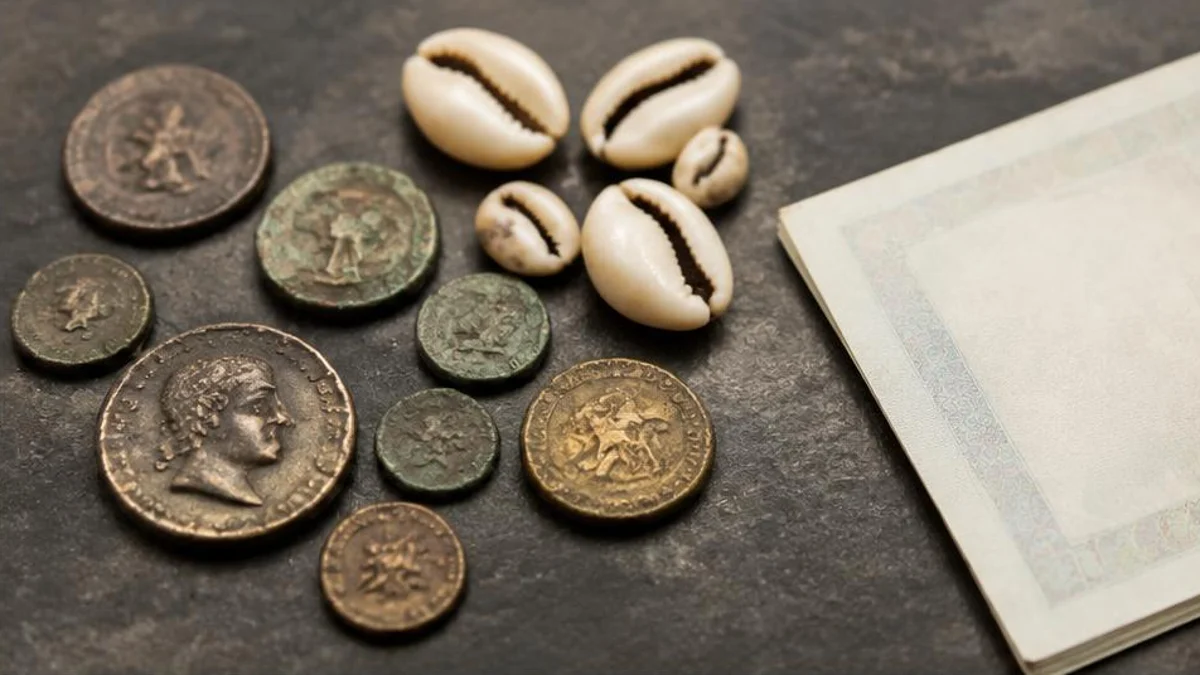
Many cultures used physical goods as money. These commodity monies had value or usefulness in themselves, or were scarce, durable and easy to recognise. Examples from different times and places include:
- Cowrie shells, used in parts of Africa, Asia and the Pacific.
- Metal objects and bars, including copper and silver in various regions.
- Grain, cattle and other goods in some societies as measures of value.
What made something suitable was not a single rule but a mix of qualities: it needed to be portable enough to carry, hard to fake, divisible, and widely accepted in the community that used it.
The arrival of coins
Stamped metal coins made payments easier because the stamp indicated weight and purity, so people did not need to weigh and test metal at every transaction. Coins from the kingdom of Lydia, made from a natural gold and silver alloy called electrum, date to around the seventh century BCE. They are often called the first coins, though the claim needs a qualification: other regions developed metal money and coinage in their own ways, and the dating of early coins is debated.
Over the following centuries, coinage spread widely. Rulers used coins to pay soldiers and officials, to collect taxes and to project authority, since their image and name appeared on the metal. That link between money and state power would remain important in later history.
Paper and early banking
Paper money has a long history in China, where paper notes circulated in earlier centuries, with the details depending on which period you consider. The reasons were practical: carrying large quantities of heavy metal coins was inconvenient, so receipts and notes that represented them became a useful substitute.
In Europe and elsewhere, merchants and banks developed bills of exchange, deposits and notes. Banks accepted deposits and issued claims that could be transferred to others. Over time, the money that mattered in an economy became less a matter of physical coins and more a matter of records of who owns what.
Gold standards and the end of convertibility
During some periods, countries tied their currencies to gold, promising that notes could be exchanged for a fixed amount of the metal. Gold standards took different forms and operated at different times, and they were never universal across the world. In the twentieth century, governments gradually moved away from them, and by the early 1970s the major currencies were no longer convertible to gold under an international system.
This is a common point of confusion. Many people assume that paper money was always backed by gold and that this backing ended abruptly. The reality is more varied: arrangements differed between countries and eras, and most economies used a mix of metal, notes and bank money.
Money today: bank deposits and fiat currency
In a modern economy, most of what people call money is not banknotes or coins at all. It is bank deposits, which are electronic records held by banks. When you pay by card or transfer, balances are adjusted in banks' records. Physical cash makes up only a small share of the total.
Modern national currencies are usually described as fiat money. The word means that their value does not come from being made of a valuable material or from being convertible into one. Instead, it rests on several supports: laws that require taxes to be paid in the currency, central banks that manage supply, trust in the issuing institutions, and the fact that people expect others to accept it. Saying that fiat money is "backed by nothing" overlooks these institutional foundations, although they can strengthen or weaken over time.
What the history teaches
Looking across these stages, a few themes repeat:
- Trust matters most. Money works when people believe others will accept it.
- Convenience drives change. Coins replaced weighing metal; notes and records replaced carrying coins.
- States and money are closely linked. Governments have long influenced money through taxes, coinage and regulation.
- Forms change but functions remain. Shells, silver, paper and digital entries all serve the same three jobs.
Frequently asked questions
Did people really use barter before money?
Barter happened, but there is little evidence it was the main system before money. Many early societies relied on credit, record-keeping and shared obligations.
Were Lydian coins the first money?
They are among the earliest known coins, from about the seventh century BCE, but money existed earlier in other forms, and other regions developed coinage independently. "First coins" is a more accurate description than "first money."
Was paper money always backed by gold?
No. Some currencies were tied to gold for certain periods, but arrangements varied by country and era, and many paper notes had no such link.
What gives modern money its value?
Legal rules, central bank management, trust in institutions and widespread acceptance. It is not tied to a physical commodity.
Is most money physical cash?
No. In most economies, the majority of money exists as electronic bank deposits.
Sources and further reading
Related reading on FactNest: The history of the world's most popular inventions and Facts about the Roman Empire.

Written by
FactNest Editorial Team
FactNest is operated by Muonix. The FactNest Editorial Team publishes general-interest explainers with AI-assisted drafting and illustrations. Contact contact@muonix.co for questions or corrections; we respond within 2 business days.
More from this author →