The bicycle looks simple, two wheels, a frame, pedals and a chain, but nobody sat down one day and invented it whole. The machine we ride today is the result of a long series of practical changes, each one fixing a problem left by the last. Some of those changes were small refinements, and a few were genuine breakthroughs. Looking at the sequence shows how invention usually works: through many people, many experiments and plenty of dead ends.
This article is an educational history. Some early details are debated by historians, so it avoids exact claims where the record is unclear.
Key takeaways
- The bicycle did not have a single inventor. It developed through a sequence of designs and improvements over decades.
- An early milestone was Karl von Drais's steerable, foot-propelled "running machine" of 1817, with no pedals. He patented it in 1818.
- Pedal-driven two-wheelers appeared in the 1860s, though who deserves credit for adding pedals is disputed.
- High-wheel bicycles gave more distance per pedal turn but were tall and risky to ride.
- The "safety bicycle" of the 1880s, with a chain drive and similar-sized wheels, resembles the modern bicycle far more closely.
- Pneumatic (air-filled) tyres, popularised in the late 1880s, made riding far more comfortable.
- Bicycles widened personal mobility, though access was uneven, depending on money, place and social attitudes.
The draisine: balance and steering without pedals
In 1817, the German inventor Karl von Drais built a two-wheeled machine that a rider sat on and pushed along the ground with their feet. It had a steerable front wheel, which was a key idea: the rider could balance and change direction. It had no pedals and no chain. Drais received a patent in 1818 for his invention, which became known as the draisine or "running machine."
The draisine was not a mass-market success, and it was heavy and made largely of wood. But it demonstrated something important: a person could balance on two in-line wheels while moving, and steering made that practical. Many later designs built on this layout.
Adding pedals: the velocipede era
For decades, two-wheelers in this style stayed foot-powered. In the 1860s, versions with pedals attached directly to the front wheel began to appear, often called velocipedes. Several makers in France and elsewhere were involved, and exactly who first attached pedals, and who deserves the credit, is a matter of debate among historians. What is clear is that pedal-driven machines became popular for a time, and riders and manufacturers experimented widely.
Early velocipedes were heavy and had solid wheels, and on rough roads they were uncomfortable, which earned them nicknames hinting at the experience. They did, however, prove that people wanted personal, human-powered transport.
The high-wheel bicycle
With pedals fixed to the front wheel, each turn of the pedals moved the bicycle forward by one turn of that wheel. To go farther with every turn, makers built bigger and bigger front wheels. The result, common in the 1870s and early 1880s, was the high-wheel bicycle, sometimes called a "penny-farthing" in Britain, after two coins of very different sizes.
High wheels had advantages: they were fast for their era and rolled over bumps more smoothly than small wheels. But the rider sat high above the ground, close to the front wheel's axle. A sudden stop or an obstacle could pitch the rider forward over the handlebars, a fall known as a "header." The design suited young, athletic riders more than most people, and it was not practical for everyone.
The safety bicycle
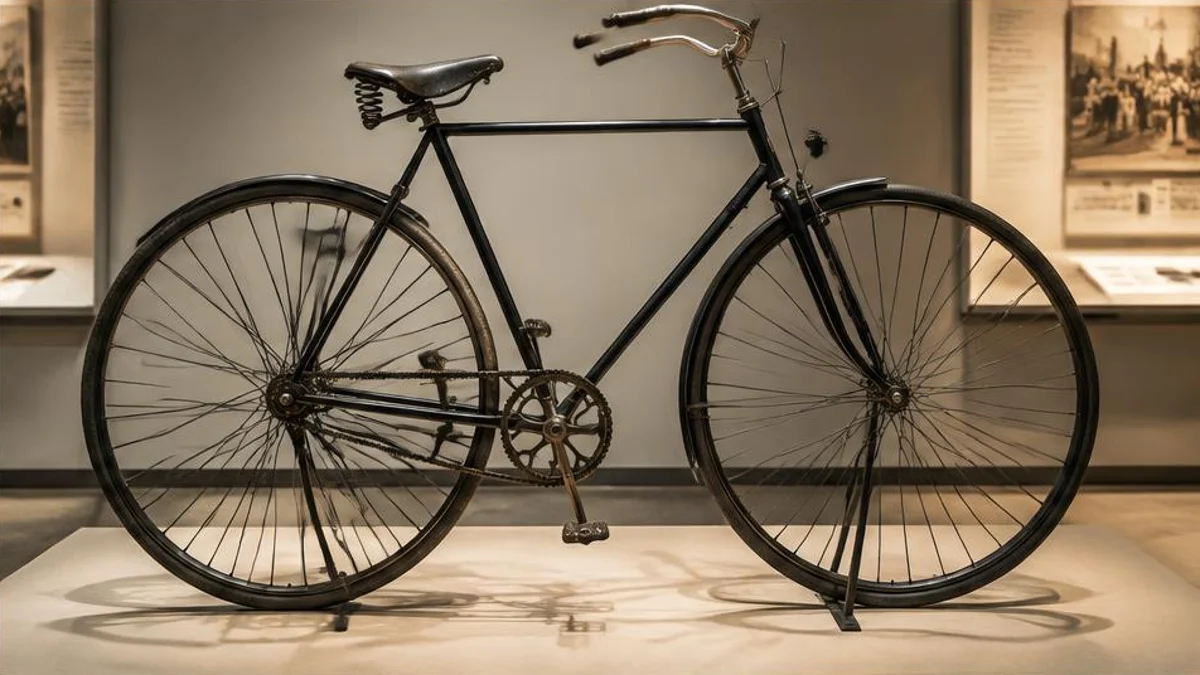
The solution was to change how power reached the wheel. Instead of fixing the pedals to the front wheel, designers moved them to the middle of the frame and used a chain to drive the rear wheel. With a suitable gear ratio, a rider could cover a good distance per pedal turn without needing a huge wheel. Both wheels could then be of similar, moderate size, and the rider sat much lower.
These designs, developed through the 1880s, became known as safety bicycles because they were much less dangerous than high wheels. The basic layout, a diamond-shaped frame, two similar wheels, a chain to the rear wheel and handlebars to steer, is still recognisable on bicycles today.
The pneumatic tyre
Early bicycles had solid rubber or metal tyres, which made for a rough ride on uneven roads. The pneumatic tyre, filled with air, absorbed bumps and made riding more comfortable. A Scottish veterinary surgeon, John Boyd Dunlop, is widely credited with developing a practical pneumatic bicycle tyre in the late 1880s, and the idea spread quickly. Earlier inventors had also explored air-filled tyres, so the idea itself was not entirely new. What changed in this period was making it work well enough for everyday use.
With safety bicycles and air-filled tyres together, cycling became far more practical and appealing to a wider range of people.
Many small refinements
After this period, progress continued through many unglamorous improvements rather than one big leap:
- Bearings that reduced friction in the wheels and pedals.
- Gears and gear mechanisms that let riders adapt to hills and different speeds.
- Better brakes to stop more reliably.
- Improved frames, wheels and materials that made bicycles lighter and stronger.
No single person is responsible for the modern bicycle. It is a good example of how a technology improves when many people try ideas, share them and build on each other's work.
Reading the timeline carefully
Popular histories sometimes squeeze the bicycle's story into a neat chain of "firsts," each tied to a single name and a single year. The surviving evidence is messier. Patents, newspaper reports, surviving machines and museum collections do not always agree, and makers in different countries often worked on similar ideas at the same time, sometimes without knowing about each other.
A few habits help when you read about the history of any invention:
- Distinguish a patent from a product. A patent date records a legal claim, not necessarily the day a working machine was first built or sold.
- Look for wording like "widely credited." It signals that experts attribute an achievement to someone while acknowledging earlier or parallel work.
- Treat precise dates for early prototypes with caution. Where records are thin, careful sources give a decade or a range rather than an exact day.
Museum collections, such as those held by national museums, are useful starting points because they describe surviving objects and note where attribution is uncertain.
What the bicycle changed
Bicycles gave many people a new way to travel under their own power, faster than walking and without the cost of keeping an animal. They affected work, leisure and social life in different places. Historians note that cycling opened up new freedom of movement for many, including women in some societies in the late nineteenth century, though this should be qualified. Access was never equal: it depended on income, on the roads available and on social attitudes, which varied widely from place to place.
It would be an overstatement to say that bicycles transformed everyone's life at once. Their impact grew over time and looked different in different communities.
Frequently asked questions
Who invented the bicycle?
No single person did. Karl von Drais built an early steerable two-wheeler in 1817, and later inventors added pedals, chains, better wheels and tyres.
Did the first bicycle have pedals?
No. Drais's draisine had none. Riders pushed with their feet. Pedals came later, with pedal-driven velocipedes in the 1860s.
Why did high-wheel bicycles have such big front wheels?
The pedals were attached directly to the front wheel, so a bigger wheel carried the bicycle farther with each pedal turn.
What is a safety bicycle?
It is a design from the 1880s with a chain driving the rear wheel and two similar-sized wheels. It was safer than the high wheel and is the ancestor of modern bicycles.
Did Dunlop invent the pneumatic tyre?
He is widely credited with developing a practical pneumatic bicycle tyre in the late 1880s, but earlier inventors had also worked on air-filled tyres.
Sources and further reading
Related reading on FactNest: The history of the world's most popular inventions and The history of the printing press.

Written by
FactNest Editorial Team
FactNest is operated by Muonix. The FactNest Editorial Team publishes general-interest explainers with AI-assisted drafting and illustrations. Contact contact@muonix.co for questions or corrections; we respond within 2 business days.
More from this author →