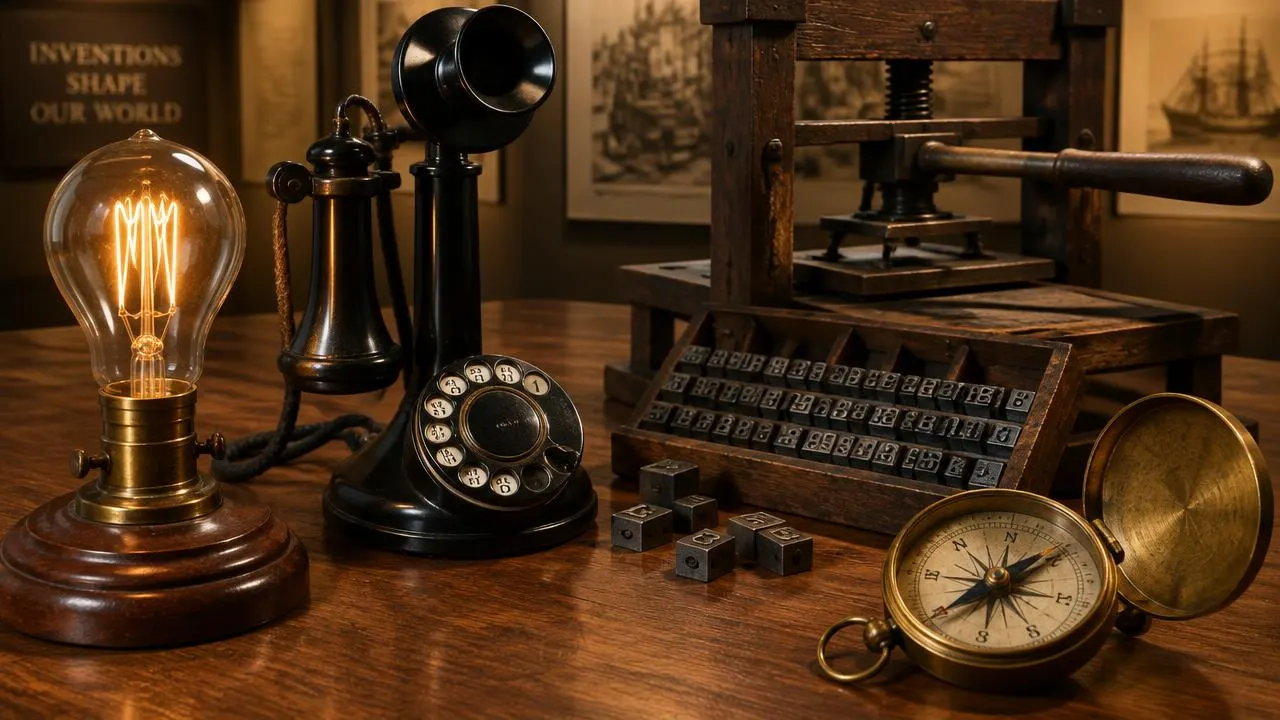
The objects that shape everyday life rarely appeared through one person’s sudden inspiration. Most emerged through accumulated knowledge, competing designs, skilled manufacturing, and infrastructure that made them practical.
Here, “popular” means familiar and widely influential, not a statistically ranked list. Looking at these inventions as evolving systems reveals contributions that single-inventor stories often hide.
Key takeaways
- The earliest surviving example is not necessarily the first ever made.
- Patents recognize specific legal claims, not every contribution to an invention.
- Commercial success depends on manufacturing, affordability, and supporting networks.
- Famous inventors deserve credit without receiving credit for everything.
The wheel: an ancient development without a known inventor
Evidence for wheeled transport appears in parts of Europe and southwestern Asia during the fourth millennium BCE. Its precise origin and routes of transmission remain debated.
The crucial invention was not simply a round object. A vehicle needed a workable relationship between wheels, axles, load-bearing structures, and surfaces over which it could move. Woodworking skill and suitable materials mattered.
Potters also used rotating devices, but the chronology does not justify a simple universal story in which one kind of wheel automatically produced the other. Different applications may have influenced each other in ways the surviving evidence cannot fully reconstruct.
A wheel becomes useful within a transport system. Draft animals, roads, maintenance, and cargo handling helped determine where wheeled vehicles offered advantages over boats, sledges, or human carriers.
Paper: more than one celebrated court official
Paper developed in China before the lifetime of Cai Lun, the court official traditionally associated with improvements reported in 105 CE. Archaeological discoveries demonstrate that papermaking had earlier roots.
Cai Lun’s importance need not disappear when the single-inventor claim is corrected. Recording, refining, and promoting a production process can be historically significant even when the underlying material already exists.
Papermaking gradually spread across Asia and into the Islamic world, then Europe. Fibers, processing methods, and workshop practices changed along the way.
Paper’s influence also depended on complementary technologies. A cheap writing surface becomes more transformative when combined with literacy, administration, inks, printing, and trade. The history is therefore about expanding capacity, not just identifying the first surviving sheet.
Printing: East Asian foundations and European transformation
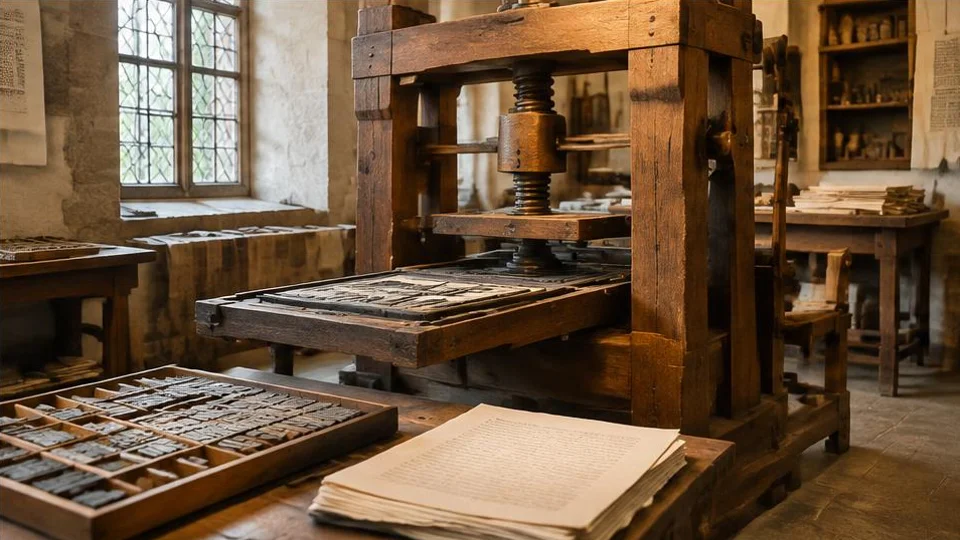
Woodblock printing developed in East Asia centuries before Gutenberg. Printers carved an entire page into a block, inked it, and transferred the image onto a writing surface.
In eleventh-century China, Bi Sheng developed movable type made from baked clay. Metal movable type later appeared in Korea. These achievements establish that movable type did not begin in fifteenth-century Europe.
Johannes Gutenberg and his collaborators nevertheless made a major contribution by developing an effective European printing system around the middle of that century. Metal type, suitable ink, a press, and repeatable production worked together.
Different writing systems and markets affected the economics of typesetting. Alphabetic European texts and texts using thousands of characters presented different practical challenges. Neither tradition should be reduced to a footnote in the other’s history.
The light bulb: a lamp plus an electrical system
Electric lighting existed before Thomas Edison’s celebrated demonstrations. Researchers and inventors had explored arc lamps and incandescent designs, while Joseph Swan developed significant incandescent lighting work in Britain.
Edison’s team improved the practical combination of filament, vacuum, electrical resistance, and production methods. His laboratory also helped develop the supporting system: generators, distribution equipment, meters, and other components.
The Smithsonian emphasizes the role of Menlo Park’s facilities and talented associates in this work. source The useful question is not whether Edison invented light from nothing, but how his organization helped make electric lighting commercially workable.
Modern lighting continued evolving after incandescent lamps became widespread. Fluorescent and LED technologies followed different technical paths. An LED lamp in a contemporary kitchen is therefore not simply Edison’s bulb with a better filament.
The telephone: contested beginnings, collective improvement
Alexander Graham Bell received a foundational United States telephone patent in 1876 and demonstrated intelligible speech transmission. Those achievements are important, but they occurred within a crowded field of electrical communication research.
Elisha Gray, Antonio Meucci, and others contributed designs, experiments, or competing approaches. Their work should neither be erased nor compressed into an equally simplistic claim that one overlooked individual unquestionably invented the entire telephone.
Early instruments also required improvement before reliable long-distance service became routine. Transmitters, switching systems, cables, amplification, and network management all mattered.
The telephone’s social power came from interconnection. An isolated instrument has limited value; a network connecting homes, businesses, and exchanges becomes a communications service. Operators, technicians, manufacturers, and standard-setting organizations helped turn a laboratory capability into everyday infrastructure.
Refrigeration: from demonstrations to dependable cold chains
People used ice and naturally cool spaces long before mechanical refrigerators. Artificial refrigeration developed through experiments involving evaporation, compression, and the behavior of gases.
William Cullen demonstrated evaporative cooling in the eighteenth century. Later contributors included Jacob Perkins, associated with an early vapor-compression patent, and engineers who developed increasingly practical commercial systems.
Household refrigerators became widely useful only after improvements in reliability, motors, manufacturing, refrigerants, and electricity access. Their spread varied greatly between countries and income groups.
Refrigeration also transformed more than kitchens. Cold storage and refrigerated transport changed food distribution and supported medicine. These benefits brought trade-offs, including electricity consumption and environmental damage from some refrigerants, which prompted further redesign and regulation.
The automobile: many routes to powered transport
Early self-propelled vehicles used steam, electricity, and internal combustion. Karl Benz’s 1886 patent is a major landmark in gasoline-car history, but automobiles did not emerge from a single isolated development.
Other engineers worked on engines, ignition, steering, tires, brakes, and transmission systems. Electric vehicles were serious participants in the early automobile market rather than a completely new twenty-first-century idea.
Henry Ford did not invent the car. Ford and his organization became influential through manufacturing methods, standardization, pricing, and scale, building on wider industrial developments.
Mass motoring also required fuel distribution, roads, repair businesses, traffic rules, and public investment. Its consequences included greater mobility alongside crashes, pollution, congestion, and changes to urban form. Adoption is not the same thing as an uncomplicated improvement.
Computers: no single machine defines the beginning
A computer can mean a mechanical calculating device, an electronic machine, a programmable system, or a stored-program general-purpose computer. Different definitions produce different historical milestones.
Charles Babbage designed ambitious mechanical computing engines. Ada Lovelace wrote influential notes on the Analytical Engine, including a published procedure intended for it, although the complete machine was not built in their lifetimes.
Twentieth-century computing involved teams developing electromechanical and electronic machines, programming methods, storage, and theoretical foundations. Wartime projects and later universities, governments, and companies contributed different advances.
The transistor and integrated circuit then made smaller and more affordable systems possible. Software, operating systems, and interfaces were equally important in turning computing power into something non-specialists could use.
The internet and the web: related, not identical
The internet grew from research on computer networking, packet switching, and communication protocols. ARPANET was an important predecessor, but it was not the whole story.
Vint Cerf and Bob Kahn played central roles in developing TCP/IP, alongside broader research and engineering communities. Many institutions subsequently expanded and standardized the network.
Tim Berners-Lee proposed the World Wide Web at CERN in 1989. The web provided a way to link and access information over the internet; it did not invent the underlying network. Email and other internet services exist independently of websites.
The National Science and Media Museum’s internet history treats this development as a story of multiple innovators and changing communities. source
FAQ
Why do textbooks name one inventor?
A person and date are easy to remember. They may identify a useful milestone, but often conceal predecessors, collaborators, and later improvements.
Does a patent prove who invented something first?
Not universally. Patents apply to particular claims within specific legal systems. Filing dates, disclosure rules, litigation, and earlier work complicate broader historical conclusions.
Is commercializing an invention less important than creating it?
Not necessarily. Making technology reliable, affordable, and accessible can be transformative. It is simply a different contribution and should be described accurately.
Where can readers check invention stories?
Start with museum collections, patent records, university histories, and archives. The Smithsonian’s invention resources provide objects and broader context. source
What to remember
Inventions are usually branching histories rather than solitary breakthroughs. Recognizing teams, predecessors, manufacturers, and users does not diminish famous innovators. It explains more accurately how ideas become technologies that reshape ordinary life.

Written by
FactNest Editorial Team
FactNest is operated by Muonix. The FactNest Editorial Team publishes general-interest explainers with AI-assisted drafting and illustrations. Contact contact@muonix.co for questions or corrections; we respond within 2 business days.
More from this author →