A solar panel does not collect heat and turn it directly into household electricity. Most panels use semiconductor materials to convert incoming light into an electric current. Other solar technologies capture heat instead, sometimes using it to generate electricity through an entirely different process.
Understanding those distinctions makes it easier to interpret installation quotes, electricity bills, and claims about what solar can realistically provide.
Key takeaways
- Photovoltaic panels convert light into direct-current electricity.
- Inverters produce the alternating current used by most household circuits.
- Output depends on sunlight, orientation, temperature, shading, and equipment losses.
- Batteries store energy; panels do not provide storage themselves.
- Ordinary grid-connected solar usually shuts down during a power cut unless suitable backup equipment is installed.
Where the energy begins
The Sun releases energy through nuclear fusion in its core. After a long journey through the Sun and then through space, some of that energy reaches Earth as electromagnetic radiation, including visible light.
The amount reaching a particular surface changes with latitude, season, time of day, cloud cover, and atmospheric conditions. A roof also receives sunlight differently depending on its slope and direction.
Sunlight includes direct radiation arriving from the Sun’s direction and diffuse radiation scattered by the atmosphere. Photovoltaic panels can use both. This explains why they can generate electricity under cloudy skies, although usually less than under otherwise comparable clear conditions.
How a photovoltaic cell produces electricity
Light transfers energy to charge carriers
A photovoltaic cell contains semiconductor material, commonly silicon. When suitable photons are absorbed, they can transfer energy to electrons, creating mobile electrons and corresponding vacancies called holes.
The cell’s engineered structure helps separate these charge carriers. With an external circuit connected, they can contribute to an electric current. Metal contacts collect the current and carry it into wiring.
Not every photon becomes useful electricity. Some light is reflected, some has insufficient energy, and some absorbed energy becomes heat. Electrical resistance and charge recombination introduce further losses. The Department of Energy explains how individual cells combine into modules and larger arrays. source
Cells become panels and arrays
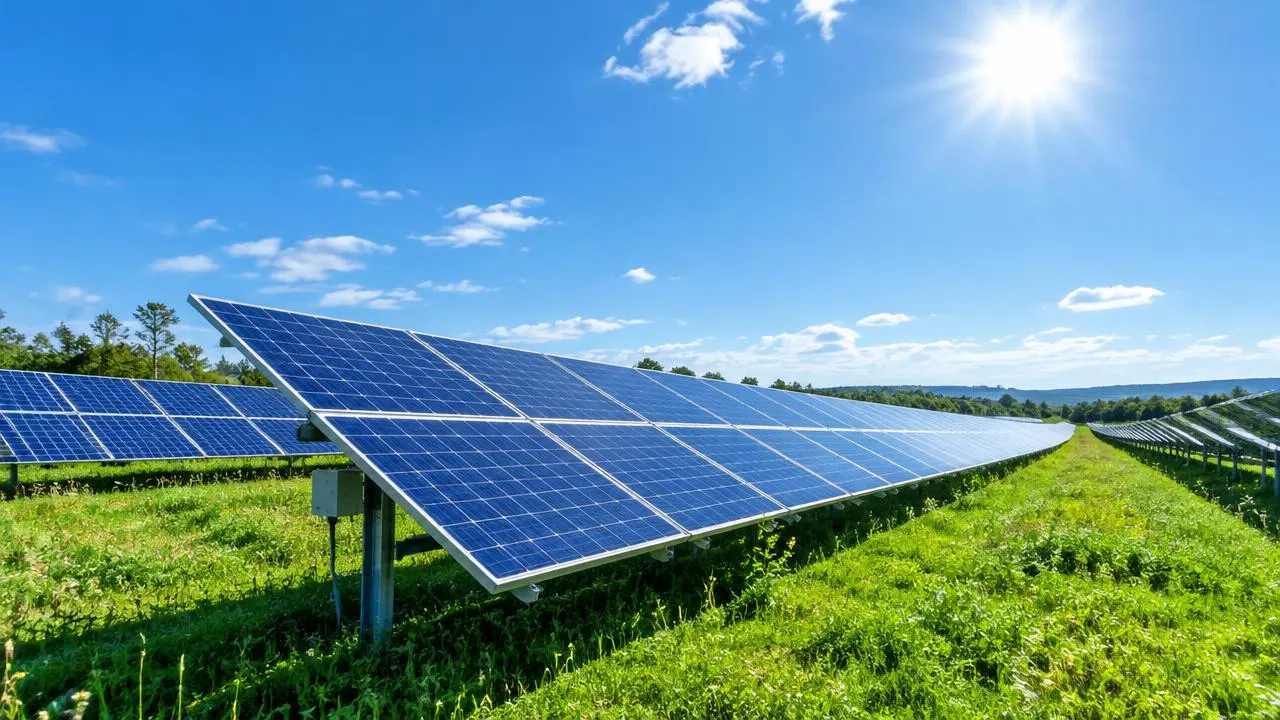
A panel contains many connected cells protected by layers such as glass, encapsulant, and a backing structure. The frame and mounting hardware hold the assembly securely in place.
Several panels connected together form an array. Their electrical arrangement determines operating voltages and currents, while the system design must meet equipment limits and local electrical requirements.
A rooftop installation therefore includes more than the visible panels. Wiring, connectors, switches, protective devices, mounts, and monitoring equipment all contribute to safe and reliable operation. Poor installation can undermine otherwise capable equipment.
Why an inverter is necessary
Photovoltaic panels produce direct current, or DC. Most household circuits and public electricity networks use alternating current, or AC. An inverter performs the conversion and controls how electricity interacts with the building or grid.
Modern inverters also monitor operating conditions and help the array work near its maximum available power. Some provide grid-support functions, subject to equipment capability and local rules. The Department of Energy describes these roles in its inverter guidance. source
A central or string inverter serves a group of panels. Microinverters operate at individual panels. Other systems combine panel-level power electronics with a central inverter. There is no universally best arrangement: shading, roof layout, maintenance access, cost, and warranty conditions all matter.
Follow the electricity through a home
Imagine a house using 1.5 kilowatts while its solar system produces 3 kilowatts of AC power. Roughly 1.5 kilowatts can serve the house, leaving another 1.5 kilowatts available for export, battery charging, or curtailment, depending on the installation.
Later, clouds reduce production to 0.5 kilowatts while household demand remains 1.5 kilowatts. The missing kilowatt must come from the grid or a battery capable of supplying it.
These are illustrative instantaneous power flows, not a prediction for a specific roof. Real systems continuously adjust as appliances switch on, sunlight changes, and equipment reaches operating limits.
Power and energy are different
A kilowatt measures power: the rate of producing or consuming energy. A kilowatt-hour measures energy accumulated over time.
If an appliance uses 1 kilowatt continuously for three hours, it consumes 3 kilowatt-hours. Likewise, a solar system averaging 2 kilowatts for five hours produces 10 kilowatt-hours.
A panel’s nameplate rating describes power under standardized test conditions. It does not promise that output all day. Comparing a system’s kilowatt rating directly with a home’s monthly kilowatt-hour consumption mixes two different quantities.
What determines solar output?
Sunlight, direction, and shade
More available sunlight generally means more potential generation. In many northern-hemisphere locations, a broadly south-facing array maximizes annual exposure; the reverse generally applies in the southern hemisphere. Local conditions can change the best design.
An east-west arrangement may sacrifice some midday peak output while spreading generation across more of the day. That can be useful when household demand or electricity prices favor morning and afternoon production.
Shading matters because cells and panels are electrically connected. Bypass diodes and panel-level electronics can reduce some losses, but they cannot replace sunlight blocked by a chimney or tree.
Temperature and other losses
Panels need light, not high air temperatures. For common silicon modules, increasing cell temperature generally reduces power output relative to otherwise comparable conditions.
Dirt, snow, wiring resistance, inverter conversion, and equipment downtime also affect production. Snow may temporarily cover panels, while cold clear weather can produce strong output when surfaces are unobstructed.
A useful estimate therefore models the actual site rather than multiplying the panel rating by daylight hours. Daylight includes weak morning and evening conditions, not continuous full-rated sunshine.
What batteries change—and what they do not
A battery stores electricity for later use. It can shift daytime solar production into the evening or provide backup when the system includes appropriate controls and electrical isolation.
Storage has losses: charging and discharging return less energy than originally supplied. Battery capacity, measured in kilowatt-hours, also differs from power capability, measured in kilowatts.
For example, a battery may store enough energy for several hours of essential lighting and refrigeration but lack the power or reserve capacity to run multiple large heating appliances. Usable capacity, reserve settings, temperature limits, and aging all matter.
Ordinary grid-tied solar generally disconnects during an outage to avoid energizing lines unexpectedly. Backup requires equipment designed to operate an isolated household circuit or local network. A battery alone does not guarantee that capability.
Solar electricity is not the same as solar heat
Solar water-heating systems use collectors to transfer sunlight’s energy into heat. That heat can warm water without first producing electricity.
Concentrating solar-thermal power takes another route: mirrors focus sunlight onto a receiver, heating a working medium. The heat can drive an engine or turbine-generator, and some installations store thermal energy for later generation. source
Unlike conventional rooftop photovoltaics, concentrating systems depend strongly on direct sunlight and are generally associated with larger projects. Choosing among technologies depends on the service needed: electricity, hot water, or industrial heat.
Environmental and practical questions
Solar generation avoids burning fuel at the point of production, but manufacturing, transport, installation, and disposal still have environmental impacts. Land use, material sourcing, recycling systems, and the electricity displaced all influence a project’s overall footprint.
For a household, useful questions include whether the roof needs replacement, how exports are compensated, whether shading will increase, and who maintains the equipment. Financial returns depend on local prices and rules, not on panel efficiency alone.
FAQ
Do solar panels work at night?
They do not produce useful electricity from ordinary nighttime conditions. A solar-equipped home can use stored energy or grid electricity after sunset.
Will panels eliminate my electricity bill?
Not necessarily. Fixed charges, seasonal shortfalls, import prices, and export compensation can leave a bill even when annual generation approaches annual consumption.
Does higher efficiency always mean better value?
No. Efficiency describes how much incoming sunlight becomes electrical output over a given area. Higher efficiency helps on limited roof space, but installed cost, reliability, and expected production also matter.
Can solar run an entire home off-grid?
Yes, with appropriately sized generation, storage, controls, and often backup generation. Designing for prolonged poor weather is much more demanding than covering average annual consumption.
What to remember
Solar works as a system: cells generate electricity, inverters make it usable, and wiring and controls manage its destination. Storage adds flexibility rather than creating extra sunlight. For further reading, use the Department of Energy’s photovoltaic, inverter, and solar-thermal guides linked above, then seek a site-specific assessment before making purchasing decisions.

Written by
FactNest Editorial Team
FactNest is operated by Muonix. The FactNest Editorial Team publishes general-interest explainers with AI-assisted drafting and illustrations. Contact contact@muonix.co for questions or corrections; we respond within 2 business days.
More from this author →