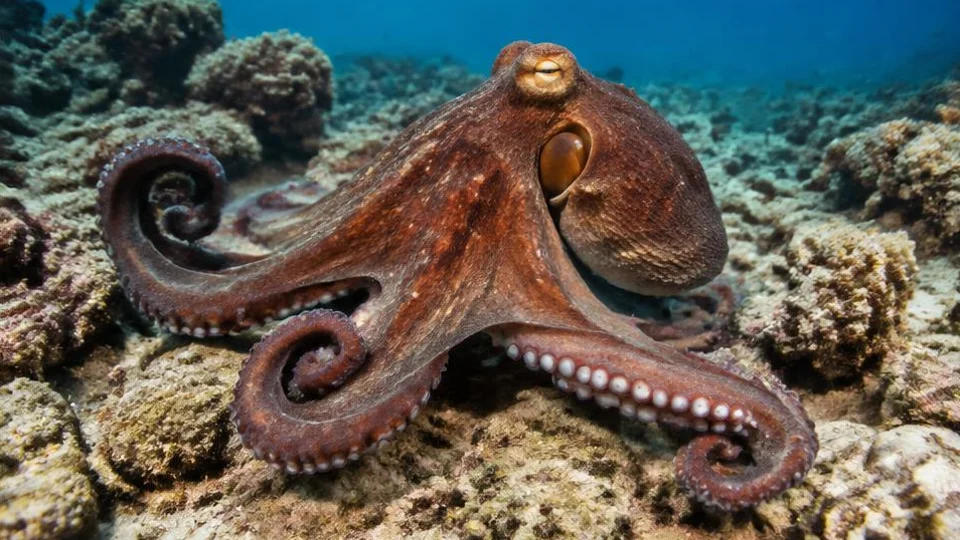
Below the sunlit surface, the ocean becomes a world of fading light, immense pressure, and unfamiliar ways of finding food. Some animals manufacture light. Microbes can build food webs using chemical energy. Landscapes include volcanic ridges, steep slopes, and trenches that reach nearly eleven kilometers below sea level.
The deep ocean is not one uniform environment, and it is not disconnected from life above. Sinking particles, moving water, migrating animals, and Earth's internal heat connect its different habitats. These facts reveal an active part of the planet rather than an empty abyss.
Key takeaways
- Light, temperature, and pressure change substantially with depth.
- Darkness does not mean the deep ocean lacks life.
- Most deep-sea food webs depend directly or indirectly on surface production.
- Chemosynthesis supports exceptional communities around vents and some seeps.
- Mapping the seabed and observing its ecosystems are different tasks.
1. The deep ocean begins before complete darkness
Definitions vary, but the deep sea is often discussed as beginning below approximately 200 meters, where sunlight becomes too weak to support substantial photosynthesis. The twilight zone extends beneath the sunlit surface, and by around 1,000 meters, usable sunlight is essentially absent. NOAA distinguishes these broad light zones in its deep-ocean introduction. source
The boundaries are approximate. Water clarity, latitude, season, and local conditions affect light penetration. A depth label should therefore be treated as a useful framework, not a universal line painted around the globe.
This also explains an apparent contradiction: a region can be called deep sea while still receiving faint sunlight. The absence of enough light for photosynthesis is not identical to the complete absence of detectable photons.
2. Pressure increases by about one atmosphere every ten meters
Water has weight, so deeper water supports a larger column above it. Pressure rises by roughly one atmosphere for every ten meters of seawater, in addition to atmospheric pressure at the surface. At about 1,000 meters, total pressure is therefore approximately 101 atmospheres. source
A simple way to appreciate the scale is to imagine repeating the surface atmospheric load approximately one hundred times. At the deepest trench depths, pressure exceeds a thousand atmospheres.
Pressure acts from all directions, not just downward. Its effects on living organisms also differ from its effects on an air-filled container. Many deep-sea animals lack large gas spaces and have biological adaptations suited to their surroundings, while human vehicles need engineered pressure resistance.
3. Deep water is usually cold, but not everywhere
Much of the deep ocean is only a few degrees above freezing. Sunlight heats the surface far more directly than the depths, and large-scale circulation helps distribute cold deep waters. NOAA describes cold temperatures as a defining challenge of many deep-sea environments. source
However, “deep” does not mean the same temperature everywhere. Water masses differ, and hydrothermal systems create extreme local contrasts. Very hot vent fluid can emerge into surrounding seawater that is close to freezing.
This is a useful distinction when reading dramatic descriptions of boiling depths. A hot outlet does not make the whole surrounding ocean hot. The steep temperature gradient near a vent is one of the features that makes the habitat unusual.
4. Animals make their own light
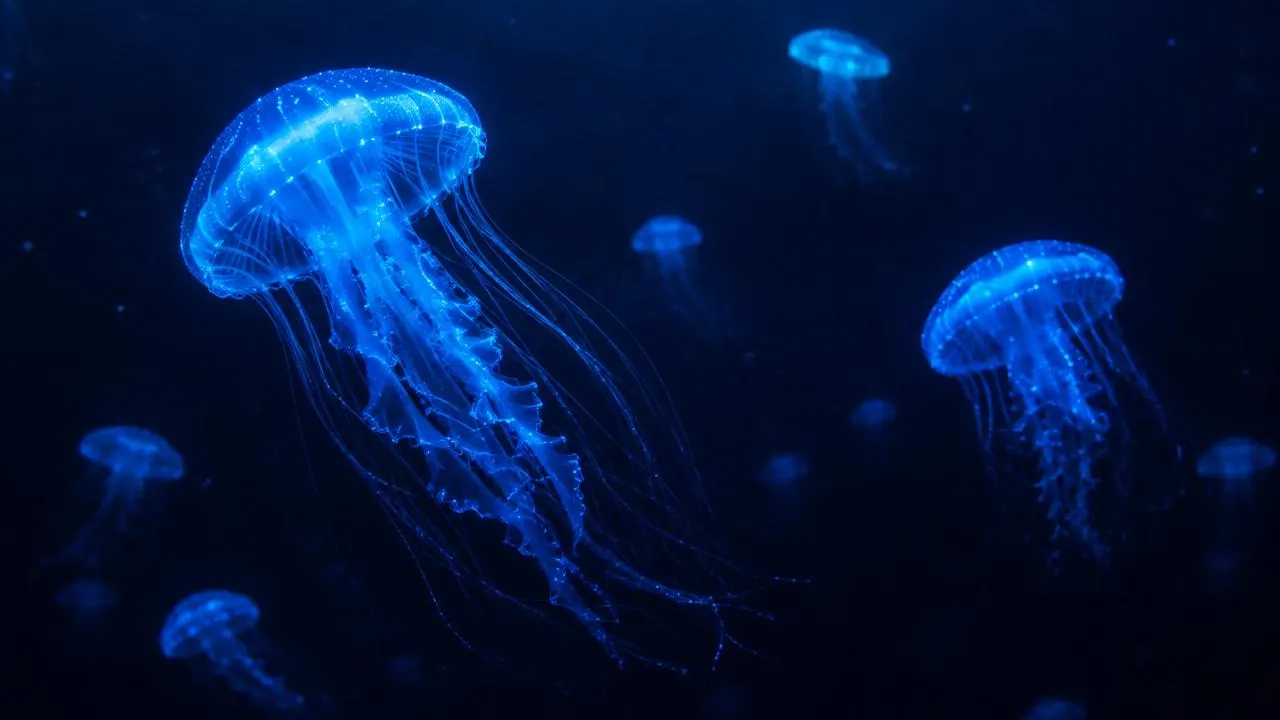
Bioluminescence is light generated through chemical reactions associated with living organisms. It occurs in many marine groups, from microbes to fish. NOAA describes functions including communication, attracting prey, and warning or evading predators. source
In dark water, light can reveal an animal, but it can also conceal or protect it. Different species use different strategies, and the purpose of a particular glow is not always known.
Bioluminescence should not be confused with fluorescence. Fluorescent materials absorb incoming light and re-emit some of its energy at another wavelength. Bioluminescent organisms generate light chemically, so they do not require an external lamp shining on them at that moment.
5. Food can arrive as “marine snow”
Many deep-sea organisms depend on organic material produced nearer the surface. Small dead organisms, waste, and other particles sink through the water, forming what researchers call marine snow. Much is consumed or decomposed before it reaches the deepest habitats.
The name describes a visual resemblance, not frozen water. Under the lights of a remotely operated vehicle, suspended and sinking particles can look like flakes in a snowstorm.
This connection means the deep sea is not entirely independent of sunlight. Although photosynthesis cannot sustain most deep habitats locally, surface photosynthesis supplies energy that moves downward through food webs. The amount and timing of that supply vary, helping shape communities far below the source.
6. Some food webs run on chemical energy
Hydrothermal vents release heated, mineral-rich fluid from the seafloor. Certain microbes use energy from chemical reactions involving substances in these environments to produce organic matter. This process, chemosynthesis, can support dense communities without relying on sunlight as the immediate energy source. source
The discovery of thriving vent communities transformed understanding of where productive ecosystems could exist. Some animals host symbiotic microbes, while others graze, filter, scavenge, or hunt within the community.
The qualification matters: not every organism beside a vent performs chemosynthesis, and not every deep-sea food web is vent-based. Chemosynthetic communities are remarkable exceptions to the dominant dependence on organic material ultimately produced in sunlit waters.
7. “Black smokers” are not underwater fires
At some hydrothermal vents, dark plumes rise from chimney-like structures. The apparent smoke consists of mineral particles forming as hot vent fluid mixes with cold seawater. The chimneys themselves develop through mineral deposition. NOAA's vent fact sheet describes the dark appearance as related to minerals and sulfides. source
No ordinary combustion is required. Calling the plume smoke is a visual analogy, much like calling sinking particles snow.
Vent systems also change. Outlets can shift or stop flowing, and the surrounding geology influences their chemistry. An ecosystem adapted to a vent is therefore living beside a dynamic energy supply rather than a permanent underwater furnace.
8. Deep-sea animals are adapted, not invulnerable
Living under high pressure does not make an animal resistant to every disturbance. Deep-sea species have different combinations of physiology, behavior, feeding strategies, and reproductive patterns. NOAA emphasizes that these unusual conditions have produced diverse adaptations rather than one universal deep-ocean design. source
Some animals conserve energy where food is scarce. Others use large sensory structures, specialized mouths, or light-producing organs. Such features should be understood in context rather than ranked as bizarre defects.
Bringing an animal rapidly to the surface can expose it to damaging changes in pressure and temperature. Photographs of retrieved specimens may therefore fail to represent the animal's appearance or behavior in its natural habitat.
9. Exploration requires more than a map
Sonar can reveal seafloor shape by measuring sound returning from the bottom. Cameras provide a much narrower but more detailed view of habitats and animals. Samples can then support chemical analyses, species identification, and other investigations.
These methods answer different questions. A mapped ridge may never have been visited by a camera, while a thoroughly filmed patch may still contain organisms that cannot be identified without sampling. NOAA presents the ocean as a major frontier precisely because describing its geography is not the same as understanding its ecosystems. source
That is why a single percentage for how much ocean is “explored” can mislead. The answer depends on whether exploration means broad mapping, high-resolution surveys, direct observation, sampling, or repeated ecological study.
Frequently asked questions
What is the deepest part of the ocean?
The Challenger Deep region of the Mariana Trench is the deepest known ocean area, reaching roughly eleven kilometers. Reported measurements differ with location, equipment, and analysis, so an approximate depth is often more appropriate than an unexplained exact figure.
Can humans visit the deep ocean?
Yes, using specially engineered submersibles. Remotely operated and autonomous vehicles also investigate places where ordinary diving is impossible. Vehicle capabilities depend on depth ratings, power, navigation, and the scientific task.
Does every deep-sea animal glow?
No. Bioluminescence is widespread but not universal, and estimates depend on the habitat and organisms being studied. A percentage measured in one region or animal group should not automatically be applied to the entire deep ocean.
Is the deep ocean unaffected by human activity?
No. Changes in ocean chemistry and climate, fishing, pollution, and direct seabed disturbance can affect deep environments. Remoteness does not guarantee protection, although impacts differ among habitats and require specific evidence to assess.
What to remember
The deep ocean is dark, pressurized, and often cold, but it is also diverse and connected to the rest of Earth. Its life depends on ingenious adaptations and several energy pathways. Understanding it requires complementary observations, not just dramatic images or sweeping statistics.
Sources and further reading

Written by
FactNest Editorial Team
FactNest is operated by Muonix. The FactNest Editorial Team publishes general-interest explainers with AI-assisted drafting and illustrations. Contact contact@muonix.co for questions or corrections; we respond within 2 business days.
More from this author →