A spam filter and a system that writes a paragraph may seem unrelated, but both can use machine learning: software that learns statistical patterns from examples. Instead of receiving a separate instruction for every possible situation, a model is trained to make predictions or produce outputs from data. That is useful, but it is not the same as human understanding. Knowing how the process works helps explain both the impressive results and the mistakes that can seem surprisingly obvious to us.
Key takeaways
- Machine learning fits patterns in data; a plausible output is not proof of understanding or accuracy.
- Training adjusts a model. Inference uses the trained model to respond to new inputs.
- Reliable evaluation uses data kept separate from training and checks for misleading shortcuts.
- Whether a system is useful depends on its task, its data and the consequences of being wrong.
What makes machine learning different from ordinary programming?
In conventional programming, people write explicit rules. A fruit-sorting program might say: if an item meets specified colour and weight conditions, put it in a particular category. The programmer chooses those conditions.
With machine learning, people instead provide a learning method, data and a goal. During training, the system adjusts a model so its outputs better match that goal. The resulting model can then process examples it did not encounter during training.
This does not mean the software invents its own purpose. People still choose what to measure, which examples to collect and what counts as a good result.
Machine learning is one approach within artificial intelligence, not a synonym for every kind of AI. Some systems rely on hand-written rules, while others combine rules with learned models. The distinction helps explain why AI applications in everyday life can work in very different ways despite sharing the same broad label.
How does a model learn from data?
The basic vocabulary describes different parts of the process. An input is what the model receives, such as a message or an image. Features are measurable characteristics used to represent that input. For a message, these might include patterns in its text; some models learn useful representations rather than relying only on features people specify.
A label is a known target attached to a training example, such as “spam” or “not spam”. Labels are used in supervised learning, but not all machine learning requires them.
Training changes parameters
A model contains adjustable internal values called parameters. During training, a learning procedure changes these values to improve performance according to a chosen objective. In many methods, this involves measuring error and repeatedly making adjustments intended to reduce it.
Parameters are not the same thing as the examples. They are part of the fitted model, although models can sometimes memorise details of training data.
Inference uses what was fitted
Inference is the stage when a trained model produces an output for an input. A prediction does not necessarily trigger further learning. Updating the model usually requires a separate training or adaptation process.
What are the main types of machine learning?
Different learning approaches provide different kinds of guidance. The categories describe how learning is organised, not a ladder from less intelligent to more intelligent.
Supervised learning: learn from examples with targets
Supervised learning uses inputs paired with known targets. A model might learn to classify messages using examples labelled by people. It can also predict a numerical value rather than a category. Its training objective rewards outputs that align more closely with the supplied targets.
The limitation is straightforward: an incorrect or poorly defined target can teach the wrong task very effectively.
Unsupervised learning: look for structure
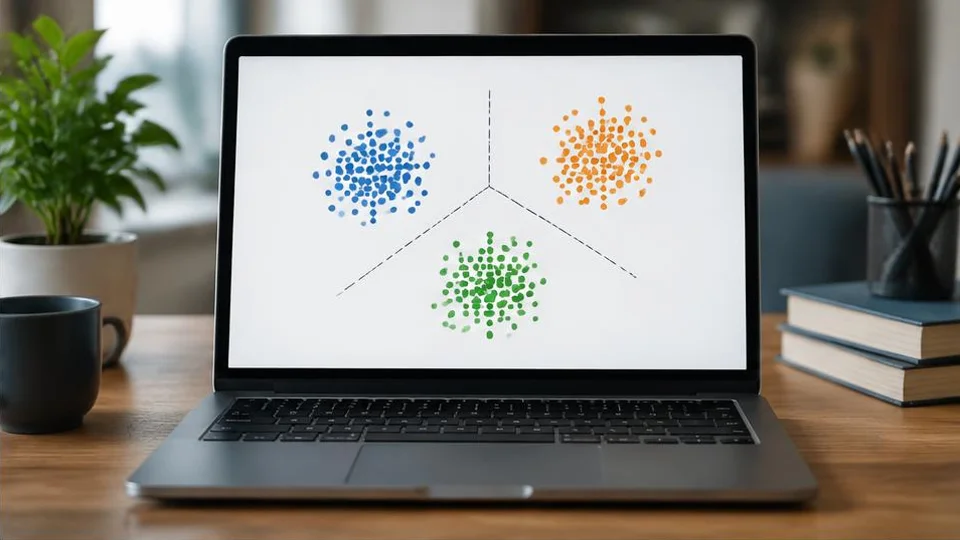
Unsupervised learning searches for structure in data without supplied target labels. It might group similar items or create a more compact representation of complicated data. The groups do not automatically carry meaningful names, and finding a pattern does not establish why it exists.
Reinforcement learning: learn through actions and feedback
In reinforcement learning, an agent takes actions in an environment and receives rewards or penalties. It learns a strategy for obtaining better cumulative rewards. The feedback can be delayed, rather than attached to each action immediately. Designing the reward matters: a strategy can score well while failing to achieve what its designers actually intended.
A worked example: sorting fruit without pretending to understand it
Consider this hypothetical teaching example. You want a model to distinguish apples from oranges using weight, colour and surface texture. You collect labelled examples of each fruit, then reserve some for later testing.
During training, the model finds combinations of features associated with each label. It might learn that a rough surface is more informative than colour because apples and oranges can overlap in colour.
Now give it an unfamiliar fruit. It produces a prediction based on the fitted pattern, not an understanding of fruit as food or of how trees grow.
The ambiguous fruit matters
A yellowish apple or unusually smooth orange may be difficult to classify. A grapefruit introduces another problem: if the system is only allowed to answer “apple” or “orange”, it may assign the wrong category confidently.
A practical observation follows: always ask what answers a model is allowed to give. An impressive-looking prediction may reflect a forced choice, not strong evidence. A useful sorting system might allow an “uncertain” outcome and route ambiguous items for inspection.
How do we know whether a model works?
Training performance is not enough. A model may fit its examples closely yet perform poorly on unfamiliar ones, a problem called overfitting. Evaluation therefore uses held-out data that was not used to fit the model. Testing should resemble the conditions in which the system will actually operate.
Data leakage happens when information unavailable at prediction time, or information from evaluation examples, improperly influences training or model development. For instance, near-identical fruit photographs appearing in both training and testing could make results look better than they deserve.
Look beyond an overall score
Biased or unrepresentative data can hide weaknesses. If the fruit collection contains only bright, evenly lit photographs, performance may fall in a dim sorting room. Likewise, a language tool tested on a narrow range of writing may struggle with other dialects or styles.
Ask which errors occur, where they occur and how costly they are. Also distinguish a model's confidence score from demonstrated reliability: a strong preference for an answer does not, by itself, establish that the answer is correct.
Where do generative systems fit?
Generative systems produce content such as text, images or audio using patterns learned during training. For example, a text model can generate a response by repeatedly predicting suitable next pieces of text from the available context.
Fluent wording is not a guarantee of factual accuracy. The training objective and generation process can produce plausible statements without establishing whether those statements are true. Tools for retrieving information may help, but their results still need appropriate checking.
Machine learning also does not inherently require an internet connection during inference. Some models run locally; others are accessed through online services. Understanding how the internet carries information between devices helps separate the network delivering a request from the model processing it. Those are connected parts of a service, not the same mechanism.
Frequently asked questions
Is machine learning the same as human learning?
No. There are loose similarities, such as improving with examples, but models fit statistical relationships through computational procedures. A model can perform well without human-like understanding of what its inputs mean. Its success on a task does not establish consciousness, intentions or the ability to transfer knowledge as a person would.
Does more training data always make a model better?
No. Additional data helps only when it contributes useful information for the task and is handled appropriately. Duplicate, inaccurate or irrelevant examples can add little value or reinforce existing problems. Coverage matters too: a larger collection that still excludes important conditions may leave the same weaknesses unresolved.
Can a machine-learning model keep learning after release?
Yes, but not every system does. Some models remain fixed until developers retrain them, while others are designed for ongoing updates. A service remembering a preference is not necessarily changing its model parameters. Continued learning also requires monitoring, because new data can introduce errors or shift performance unexpectedly.
When is machine learning unnecessary?
When a task has clear, stable rules, ordinary programming may be simpler and easier to check. Calculating a total from known prices does not require learning patterns from examples. Machine learning is more relevant when useful relationships are difficult to specify directly and suitable data exists to learn and evaluate them.
Read the prediction, then question the evidence
The most useful question is not whether a model seems clever. Ask what it learned from, what it was tested on and what happens when it is wrong. Those questions turn a mysterious output into something you can assess more carefully.
Sources and further reading

Written by
FactNest Editorial Team
FactNest is operated by Muonix. The FactNest Editorial Team publishes general-interest explainers with AI-assisted drafting and illustrations. Contact contact@muonix.co for questions or corrections; we respond within 2 business days.
More from this author →