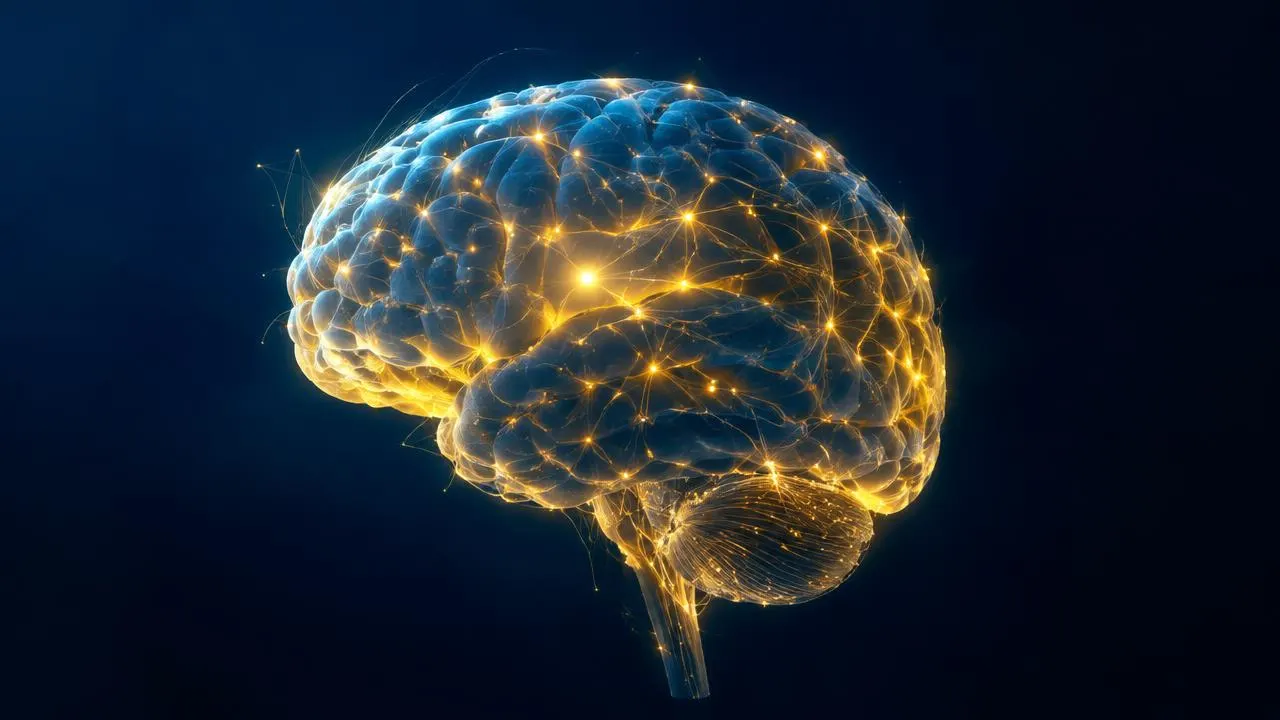
Your brain makes reading this sentence feel effortless. Meanwhile, it is interpreting shapes, retrieving vocabulary, directing eye movements, monitoring your surroundings, and helping regulate your body. Most of that work happens without entering conscious awareness.
The brain is not a collection of isolated switches, and it is not simply a biological computer. It is living tissue whose cells continually interact with the body and the outside world. These ten facts explain some of its remarkable abilities while separating established knowledge from familiar exaggerations.
Key takeaways
- Brain functions emerge from interacting networks, not independent compartments.
- Neurons communicate through electrical activity and chemical signaling.
- Learning changes connections, but brain plasticity has limits.
- Memory, perception, movement, and sleep involve active processing.
- Popular claims about unused brain capacity oversimplify the science.
1. Your brain contains more than 80 billion neurons
Neurons are specialized cells that receive and transmit information. The human brain contains more than 80 billion of them, according to the National Institute of Neurological Disorders and Stroke. That number is an estimate of a biological population, not an exact specification shared by every person. source
The connections matter as much as the count. A neuron can interact with many other cells, creating circuits that support sensation, movement, and thought. Comparing brains solely by neuron totals would be like judging transportation systems only by how many stations they contain, without examining their routes or services.
2. Brain messages are both electrical and chemical
Within a neuron, changes in electrical voltage can travel along its axon as action potentials. At many connections between neurons, the arriving signal triggers the release of chemical messengers called neurotransmitters. These cross a tiny gap and influence the receiving cell. Electrical connections between neurons also exist. source
This is not electricity flowing through a household wire. Neuronal signaling depends on charged particles moving across cell membranes and on carefully regulated molecular machinery. Different neurotransmitters and receptors can increase or decrease the likelihood of further activity, allowing circuits to respond flexibly rather than simply passing every message onward.
3. Different regions specialize, but they work together
Brain regions have distinctive responsibilities. The cerebellum helps coordinate movement, the brainstem supports vital functions, and the cerebrum contributes to conscious thought, sensory processing, and planning. These specializations do not mean that each complex ability occupies one neatly bounded location. source
Consider catching a ball. Visual systems estimate its movement, other networks help predict where it will arrive, and motor circuits coordinate your arm and hand. Balance and sensory feedback keep the action on track. Even a seemingly simple task depends on communication among multiple systems, which is why brain diagrams are useful guides rather than complete maps of behavior.
4. The brain is supported by more than neurons
Neurons receive much of the attention, but they do not operate alone. Glial cells perform essential supporting and regulatory roles. Different glia help maintain the chemical environment, form insulating myelin around many axons, and participate in immune defense and responses to injury. source
Calling these cells mere packing material misses their importance. A communication network needs more than message carriers: it also needs maintenance, energy support, and protection. That comparison is imperfect, but it illustrates why understanding the brain requires studying the interactions among many cell types, not just tracing the electrical activity of neurons.
5. Your brain changes when you learn
Learning involves changes in neural circuits, including adjustments in the effectiveness of connections between cells. This capacity for change is called plasticity. It supports the acquisition of skills and helps explain why repeated practice can make an unfamiliar action more reliable. source
Imagine learning a short piano sequence. Initially, you may consciously track every finger movement. With practice, the sequence can become smoother and require less deliberate attention. That does not mean the brain has created an entirely new region for the tune. Existing networks have adapted. Plasticity also has constraints: it does not guarantee unlimited learning or complete recovery after injury.
6. Memory is not stored like a video recording
Memory depends on interacting brain systems. The hippocampus is especially important for forming certain new memories, while other regions contribute to skills, emotional associations, and the information eventually retained across longer periods. There is no single mental cupboard containing every experience. source
Remembering an event involves retrieving and reconstructing information rather than replaying a flawless recording. For a practical illustration, think about describing a familiar room without looking at it. You may recall its general arrangement but miss the exact position of a small object. A vivid recollection can still be incomplete; confidence and accuracy are not interchangeable.
7. Your senses require interpretation
The eyes, ears, skin, nose, and tongue provide information, but the brain processes that information into usable perceptions. Different areas of the cerebral cortex help interpret incoming sensory signals and connect them with other information. Seeing therefore involves more than light entering the eyes. source
A familiar illustration is recognizing a friend's voice in a busy room. Your auditory system must separate overlapping sounds and relate some of them to a known person. Perception is remarkably effective, but it is selective and context-sensitive. What you notice depends partly on attention, expectations, and the quality of the incoming signal.
8. The brain does not switch off during sleep
Sleep is an active, changing state. During the night, the brain moves through non-REM and REM sleep, with different patterns of activity. Sleep supports learning and memory, and insufficient sleep can make concentration and rapid responses more difficult. source
During REM sleep, brain activity can resemble aspects of wakefulness even though the sleeper is largely disconnected from the surroundings. This explains why describing sleep as simply resting an inactive brain is misleading. The brain is doing different work, not no work. Researchers are still investigating how its many nighttime processes fit together.
9. Much of the brain's work never becomes conscious
You do not need to deliberately command each breath or continuously calculate your heart rate. Brainstem and other regulatory circuits help maintain essential functions automatically, while interacting with signals from elsewhere in the body. Conscious control can influence some processes without taking over their full operation. source
Walking provides another illustration. You can decide where to go, but you usually do not consciously specify every muscle contraction. Automatic processing is not a lesser form of brain function. It is part of what makes complex behavior possible while leaving attention available for conversation, navigation, or unexpected obstacles.
10. The “10 percent” idea misrepresents how brains work
There is no established reserve containing 90 percent of the brain that healthy people never use. Different tasks recruit different networks, and many brain systems remain active outside deliberate tasks. The brain's specialized regions contribute across a wide range of functions. source
However, rejecting that myth does not mean every neuron fires simultaneously. Coordinated activity includes both excitation and inhibition. More activity is not automatically better, just as having every instrument play at maximum volume would not improve an orchestra. Effective brain function depends on appropriate patterns, timing, and communication.
Frequently asked questions
Is a bigger brain necessarily a smarter brain?
No. Size alone cannot capture intelligence or cognitive ability. Organization, connectivity, development, and the demands placed on different systems all matter. Simple comparisons can be misleading, especially across species with different bodies and sensory specializations.
Can adults still learn new skills?
Yes. Adult brains retain plasticity, although learning varies with the skill, practice, prior knowledge, and other conditions. Plasticity should not be confused with the claim that every brain region regenerates freely or that all injuries are reversible.
Are people strictly left-brained or right-brained?
No. Some functions show hemispheric specialization, but ordinary activities involve cooperation across the brain. Labels assigning logical people to one hemisphere and creative people to the other turn a real anatomical distinction into an unsupported personality rule.
Does forgetting always indicate a brain disorder?
No. Occasional forgetting can occur in everyday life, and attention strongly affects what gets remembered. Persistent or worsening changes need individual clinical assessment; an educational article cannot determine their cause or significance.
What to remember
The brain's most striking feature is not one spectacular statistic. It is the coordination of billions of cells across changing networks. Learning, remembering, sensing, and sleeping reveal an organ that is continuously active, adaptable, and dependent on its connections.
Sources and further reading

Written by
FactNest Editorial Team
FactNest is operated by Muonix. The FactNest Editorial Team publishes general-interest explainers with AI-assisted drafting and illustrations. Contact contact@muonix.co for questions or corrections; we respond within 2 business days.
More from this author →