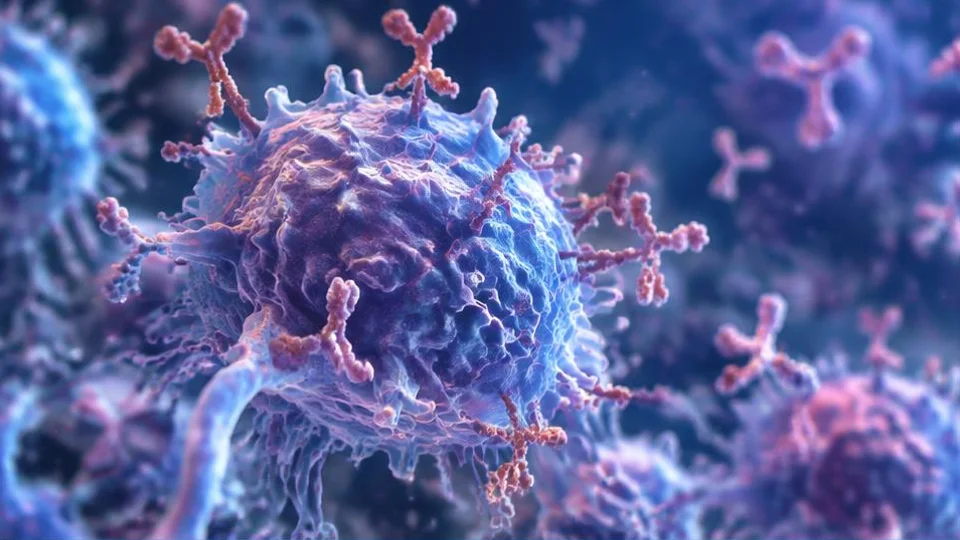
A vaccine gives the immune system a preview of something it may need to recognise later. That preview does not have to be a whole pathogen: it may be an inactivated organism, a selected component, or instructions for making a particular protein. The important result is a biological change in the person receiving it. Cells that recognise the target become activated, some produce an immediate response, and others remain as memory cells. Understanding that sequence helps explain both the power of vaccination and its limits.
Key takeaways
- Vaccines present antigens, or instructions for producing them, so the adaptive immune system can learn to recognise a target.
- B cells produce antibodies; T cells perform several jobs, including coordinating responses and recognising infected cells.
- Memory B and T cells can persist after the initial response subsides, supporting a faster response to later exposure.
- Protection develops over time and varies by vaccine and pathogen. Immune memory does not mean absolute or lifelong protection.
Recognition begins with an antigen
An antigen is a substance the adaptive immune system can specifically recognise. For vaccination, the relevant antigen is generally associated with a pathogen, but it is not necessarily a complete infectious organism. A protein from the surface of a virus, for example, can provide a recognisable target without being a virus itself.
The immune system has interacting layers. Innate defences respond broadly to signs of infection or tissue disturbance. Adaptive responses are more selective: particular B cells and T cells recognise particular molecular features. Vaccination connects these layers rather than bypassing the body's existing defences.
How the target gets introduced
Antigen-presenting cells take up material and display fragments to T cells. Together with additional signals, this presentation helps activate suitable cells and shape the response. B cells can recognise antigens directly through receptors on their surfaces.
Recognition is therefore not simply a matter of an antigen arriving. Its form, how it is delivered, and the surrounding immune signals influence the response that follows.
B cells and T cells divide the work
Once suitable cells are activated, they multiply, expanding the population able to respond to that target. This selective expansion is central to vaccination: the immune system builds up cells with useful recognition abilities rather than strengthening every defence indiscriminately.
Antibodies act outside cells
Activated B cells can develop into plasma cells, which release antibodies. These proteins bind particular features of an antigen. Depending on their target, antibodies may block a pathogen from entering cells or help other immune components clear it. Binding alone, however, does not guarantee that an antibody will prevent infection.
T cells have several roles
Helper T cells support and coordinate responses, including many B-cell responses. Cytotoxic T cells can recognise and destroy infected cells displaying relevant antigen fragments. Not every vaccine produces these responses to the same degree.
Immune communication is biochemical, not conscious. The distinction is also useful when exploring how plants communicate through chemical signals: responding to a signal does not require thought. In vaccination, signals guide which immune cells activate, multiply, and survive.
Different vaccine platforms provide different previews
Vaccine platforms differ in what they deliver and how the immune system encounters the antigen. They share a broad purpose, but their biological routes are not interchangeable.
Inactivated and live attenuated vaccines
Inactivated vaccines contain organisms that have been rendered unable to replicate. They still carry antigens that the immune system can recognise. Because they cannot multiply, their presentation of antigen differs from that of a replicating organism.
Live attenuated vaccines contain weakened forms of a pathogen that can replicate to a limited extent. This can resemble aspects of natural infection and stimulate a broad immune response. “Weakened” does not mean suitable for everyone or incapable of causing adverse effects.
Subunit and mRNA vaccines
Subunit vaccines supply selected components, such as proteins or sugars, rather than an entire pathogen. Some formulations include an adjuvant, an ingredient that helps strengthen the immune response to the antigen.
mRNA vaccines deliver temporary instructions that cells use to make an antigen, typically a protein. The immune system responds to that protein; the mRNA is subsequently broken down. The instructions do not need to enter the cell nucleus or alter DNA to work.
Platform alone does not determine how well a vaccine protects. The chosen antigen and the characteristics of the pathogen also matter.
Memory is a lasting cellular change
After the initial response, many activated immune cells disappear as the response contracts. Some B cells and T cells persist as memory cells. Long-lived plasma cells can also continue producing antibodies, although antibody levels may change over time.
Immune memory is not a stored picture of a germ. It is a changed population of cells, with receptors and response capabilities shaped by previous exposure. Unlike the memory discussed in these facts about how the human brain works, immune memory does not depend on conscious recall or networks of neurons.
Why protection takes time
Recognition, cell multiplication, and development into specialised cells require time. In many antibody responses, selection also favours B cells whose antibodies bind the antigen more effectively. Vaccination therefore does not create full protection at the instant of administration.
Later exposure to a matching antigen can reactivate memory cells. That response is generally quicker than a first encounter, but it still involves biological processes rather than an instantaneous shield.
Why protection has limits
Preventing infection and limiting illness are related but different outcomes. A pathogen may begin multiplying before a recalled immune response becomes strong enough to control it. Even when infection occurs, existing antibodies and memory responses may help restrict its progress.
The balance varies with the pathogen and vaccine. It also depends on where infection begins, how quickly the pathogen spreads, and how closely its antigens match those encountered during vaccination. Changes in a pathogen can reduce recognition by some antibodies without necessarily erasing every component of immune memory.
Protection can also change as circulating antibody levels decline or other parts of the response evolve. A lower antibody measurement does not automatically mean that all protection has disappeared: memory cells are a different part of the picture. Conversely, detectable antibodies alone cannot establish complete protection.
These distinctions explain why “immune” should not be treated as a simple on-or-off status. Protection has several components, and they need not last equally long.
A worked example: preparation versus first exposure
Illustrative example: Imagine a vaccine that presents a surface protein from a hypothetical virus. A B cell recognises part of that protein, receives appropriate support, and produces descendants. Some become antibody-secreting cells; others become memory B cells. Relevant T-cell populations also respond.
Later, the person encounters a virus carrying a sufficiently similar protein. Antibodies already present may bind it immediately. If infection begins, memory cells can help mount a quicker response than would usually occur without prior recognition. Neither step guarantees that every viral particle is stopped.
A useful observation follows: visible symptoms after vaccination are not a direct readout of this sequence. A sore arm or fever can reflect inflammatory activity, but their presence does not measure the quality of immune memory. Their absence does not show that recognition failed. Much of the adaptive response happens without anything a person can feel.
Frequently asked questions
Do vaccines give you the disease they target?
That depends on what “give you the disease” means and which platform is involved. Inactivated and subunit vaccines cannot reproduce as the target pathogen. mRNA vaccines supply instructions for an antigen, not a complete pathogen. Live attenuated vaccines behave differently because they contain weakened, replicating organisms. Adverse effects remain possible, and platform-specific distinctions matter.
Are antibodies the whole immune response?
No. Antibodies are important, but they are only one component. B cells include memory populations as well as antibody-producing descendants, while T cells coordinate responses or recognise infected cells. Measuring antibodies can answer useful questions, but it does not capture every aspect of immune memory or establish an absolute boundary between protected and unprotected.
Why can additional vaccine doses help?
Another encounter with an antigen can expand relevant cell populations and strengthen or refine parts of the response. It may increase antibody levels or reinforce memory. Whether additional doses are useful depends on the vaccine, pathogen, and evidence about protection. This biological principle does not imply one universal vaccination schedule.
Does immune memory last forever?
Not necessarily. Some memory cells persist for long periods, but the durability of protection varies. Circulating antibodies, memory cells, and the pathogen itself can change. Lasting recognition may still help without preventing every infection. It is therefore more accurate to ask what kind of protection remains than whether memory simply exists or has vanished.
Preparation, not an impenetrable barrier
Vaccination changes the immune system's starting position. Instead of meeting a target with only an unprepared adaptive response, the body may already have antibodies and specialised memory cells available. That head start is the central mechanism—not a promise that exposure, infection, or illness becomes impossible.
Sources and further reading

Written by
FactNest Editorial Team
FactNest is operated by Muonix. The FactNest Editorial Team publishes general-interest explainers with AI-assisted drafting and illustrations. Contact contact@muonix.co for questions or corrections; we respond within 2 business days.
More from this author →