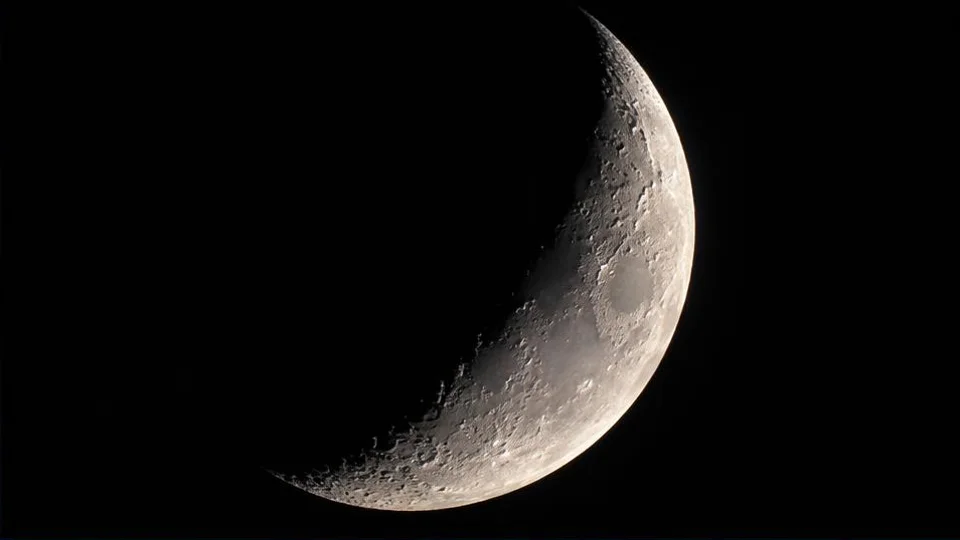
The Moon can look like a narrow hook, a bright semicircle, or an almost complete disc with a bite missing. Yet its shape has not changed, and nothing usually slides across it to make those patterns. What changes is our view of its sunlit surface as it travels around Earth. Once you separate the Moon’s physical shape from the portion illuminated for us to see, the whole cycle becomes easier to picture—and you can start predicting what tonight’s Moon might do next.
Key takeaways
- The Moon reflects sunlight. Roughly half its surface is illuminated at once, but we see different amounts of that illuminated half.
- Lunar phases come from changing Sun–Earth–Moon geometry, not Earth’s shadow.
- The phase cycle takes about 29.5 days, longer than the Moon’s approximately 27.3-day orbit relative to the stars.
- People worldwide share the same phase at a given moment, although its orientation and visibility differ.
A lit sphere, viewed from a moving angle
Imagine the Moon as a ball with sunlight arriving from one direction. The side facing the Sun is bright; the side facing away is dark. Meanwhile, an observer on Earth can see only the hemisphere facing Earth. The phase depends on how much those two hemispheres overlap in our view.
When the Moon lies roughly in the Sun’s direction in our sky, its illuminated half points mostly away from us. When it lies opposite the Sun, that half points toward us. Between those arrangements, we see a mixture of lunar day and lunar night.
The boundary is not an approaching object
The dividing line between lunar daylight and darkness is called the terminator. Its appearance changes because we view a curved surface from different angles. It is not the edge of Earth’s shadow moving across the Moon. The apparently missing part remains there, simply outside direct sunlight.
The familiar sequence of eight phases
Astronomers and calendars commonly describe eight phases, although the Moon changes continuously rather than jumping between fixed shapes. Follow the sequence by asking whether the visible illuminated area is increasing or decreasing:
- New Moon: The illuminated side faces mostly away from Earth, leaving the visible side mostly dark.
- Waxing crescent: A thin illuminated sliver grows. “Waxing” means the visible bright portion is increasing.
- First quarter: Half the apparent disc is illuminated as the Moon reaches the quarter-cycle stage.
- Waxing gibbous: More than half the disc is illuminated, and the bright area continues growing.
- Full Moon: The illuminated side faces Earth, making the disc appear fully bright.
- Waning gibbous: The visible illuminated area begins decreasing but still covers more than half the disc.
- Last quarter: Half the apparent disc is illuminated again, now during the shrinking part of the cycle.
- Waning crescent: The remaining bright sliver narrows as the Moon approaches new again.
Why “quarter” looks like half
“Quarter” describes the Moon’s progress through its cycle, not the fraction of the disc that looks bright. “Gibbous” describes the rounded appearance between a half-lit disc and a full one. These terms let you name both a shape and its direction of change.
Why an orbit and a phase cycle differ
The Moon takes about 27.3 days to orbit Earth relative to distant stars. This is its sidereal period: imagine tracking when the Moon returns to approximately the same direction against the stellar background.
But the phase depends on the Sun’s direction, not the stars. During that lunar orbit, Earth also moves along its orbit around the Sun. As a result, the direction from Earth toward the Sun has shifted. The Moon must travel farther around Earth before it reaches the same Sun–Earth–Moon arrangement again.
That longer interval, about 29.5 days, is the synodic period, or phase cycle. Neither measurement contradicts the other; they use different reference points.
This distinction is useful beyond lunar calendars. As with many surprising facts about space, the explanation becomes clearer when you ask what something is being measured relative to. Returning to a stellar direction is not quite the same as returning to the same illumination geometry.
Why phases are not eclipses
An ordinary crescent is not a Moon partly hidden inside Earth’s shadow. Earth’s shadow points away from the Sun, whereas a crescent Moon appears relatively near the Sun’s direction in the sky. Its dark portion is the Moon’s own nighttime side.
A lunar eclipse is different: Earth lies between the Sun and Moon, and the Moon passes into Earth’s shadow. That requires a more precise alignment than an ordinary full Moon.
Why eclipses do not happen every cycle
The Moon’s orbital plane is tilted relative to Earth’s orbital plane around the Sun. Most months, the full Moon passes above or below Earth’s shadow rather than through it. Similarly, most new Moons do not cross directly in front of the Sun from our viewpoint.
So a full Moon provides the appropriate phase for a lunar eclipse, but phase alone is not enough. The orbital alignment must also place the Moon in the shadow’s path.
One phase, different views around Earth
Someone in the Northern Hemisphere and someone in the Southern Hemisphere see essentially the same illuminated fraction at the same moment. Their location does not turn a waxing Moon into a waning one. However, the bright portion can appear on different sides because their viewing orientations differ.
The Moon can also look tilted differently as it moves across a local sky. That makes rules such as “bright on the right means waxing” unreliable for an international audience. A better method is to compare its illuminated fraction across successive observations.
Visibility is a separate question
Sharing a phase does not mean everyone can see the Moon simultaneously. It may be below the horizon, hidden by clouds, or difficult to pick out against daylight.
The Moon can be visible during the day because its reflected sunlight reaches us through the bright sky. The atmospheric scattering behind why the sky looks blue explains that bright background, not the Moon’s changing phase.
Make the geometry visible for yourself
A simple indoor model separates the illumination from your viewing position. Use a small ball and a lamp in a dim room. Keep the lamp fixed and safely away from fabric, and let your head represent Earth. There is no need to use or look at the Sun.
Hold the ball at arm’s length and move it around you while watching its illuminated portion. Keep it slightly above your eye line so your head does not cast a shadow on it; that would model an eclipse rather than an ordinary phase.
With the ball toward the lamp, its near side looks mostly dark. Sideways to the lamp, it looks half-lit. Opposite the lamp, it looks full.
An illustrative observing example
Suppose you notice a crescent after sunset. Sketch its bright area and compare it with another observation on a later clear evening. If the illuminated fraction has grown, it is waxing. Record its tilt separately: orientation and phase are different observations.
Frequently asked questions
Does the Moon produce its own visible light?
The light that makes the Moon bright in our sky is reflected sunlight, not visible light generated by the Moon itself. Its surface redirects some incoming sunlight toward Earth. The phase tells us how much of the directly sunlit hemisphere is presented to our view, rather than how much light the Moon is producing.
Why can I sometimes see the dark part of a crescent Moon?
The faint glow is called earthshine. Sunlight reflects from Earth toward the Moon, softly illuminating the part not receiving direct sunlight, and some of that light returns to us. It can reveal the outline of the otherwise dark disc beside a bright crescent without changing which phase the Moon is in.
Is the far side always dark?
No. “Far side” means the side facing away from Earth, not a permanently unlit hemisphere. As the Moon orbits, sunlight reaches different areas of its surface. Around new Moon, much of the far side is sunlit while the near side faces night. The phrases “far side” and “dark side” therefore describe different things.
Can I identify a phase from a photograph alone?
You can usually recognise a crescent, half-lit disc, gibbous shape, or full-looking Moon. Distinguishing waxing from waning is harder without knowing the image’s orientation and observing context. A photograph may have been rotated or mirrored. Comparing dated observations or checking a phase calendar is more dependable than assuming a particular bright-side direction.
Read the light, not just the outline
The next time you spot the Moon, imagine sunlight arriving from beyond the frame of your view. Its bright portion is a clue to that direction. The changing outline then becomes evidence of orbital geometry, not a changing Moon.
Sources and further reading

Written by
FactNest Editorial Team
FactNest is operated by Muonix. The FactNest Editorial Team publishes general-interest explainers with AI-assisted drafting and illustrations. Contact contact@muonix.co for questions or corrections; we respond within 2 business days.
More from this author →