A clear blue sky can look like a colored ceiling stretching over Earth. In reality, there is no blue surface overhead. The color comes from sunlight interacting with the atmosphere, followed by your eyes and brain interpreting the light that arrives.
The basic explanation is short: air molecules scatter shorter visible wavelengths more strongly than longer ones. But that principle also explains pale horizons, warm sunsets, and why a sunlit landscape can sit beneath a black sky on the Moon. Understanding the details turns familiar scenery into an accessible lesson in physics.
Key takeaways
- Sunlight contains a mixture of visible wavelengths.
- Air molecules redirect some sunlight through Rayleigh scattering.
- Shorter visible wavelengths scatter more strongly than longer ones.
- Sky color depends on atmospheric conditions and human vision.
- Blue skies are not reflections of the ocean.
Start with sunlight, not the atmosphere
Sunlight that looks white contains a broad mixture of visible wavelengths. A prism can spread this mixture into colors because different wavelengths bend by different amounts when passing through the material. Blue light has a shorter wavelength than red light. source
Wavelength is the distance between corresponding points on successive waves. Visible light occupies only a small part of the electromagnetic spectrum; radio waves, infrared radiation, ultraviolet radiation, and X-rays belong to the same larger family.
It is important not to imagine sunlight as equal scoops of separate paint colors. Its spectrum varies with wavelength, and our visual system does not respond equally to every wavelength. The color we perceive emerges from both the arriving light and the way our eyes detect it.
How air redirects light
The principle of Rayleigh scattering
As sunlight passes through the atmosphere, molecules interact with its electromagnetic field and redirect a small portion of the light. For particles much smaller than the wavelength, this behavior is described by Rayleigh scattering. In clear air, nitrogen and oxygen molecules are major contributors. NASA identifies preferential scattering of shorter wavelengths as the central explanation for a blue sky. source
The approximate wavelength dependence is especially revealing: scattering strength varies inversely with the fourth power of wavelength. A modest difference in wavelength can therefore create a substantial difference in scattering.
For illustration, compare blue light at 450 nanometers with red light at 650 nanometers. The ratio is approximately (650 / 450)^4, or 4.4. Under the assumptions of the Rayleigh model, that blue wavelength scatters about four times as strongly as that red wavelength. This is an illustrative calculation, not a complete prediction of the sky's exact color.
Why light reaches you from overhead
If sunlight traveled through empty space without being redirected, you would see the bright Sun but little light arriving from other directions. Earth's atmosphere changes that situation. Some sunlight is scattered toward your eyes from air along your line of sight.
When you look away from the Sun into clear daytime sky, that scattered light is enriched in shorter visible wavelengths. The whole atmosphere is not glowing blue in the same way as a blue lamp. You are receiving a particular mixture of redirected sunlight.
Why isn't the sky violet?
Violet wavelengths are shorter than blue wavelengths, so the scattering rule alone might suggest a violet sky. That conclusion leaves out the spectrum of sunlight and the response of human vision.
The light reaching the atmosphere is not equally strong at every wavelength, and human eyes are less sensitive to violet than to much of the blue and green region. Our cone cells have broad, overlapping sensitivities rather than separate detectors for every named color. Together, these factors make the scattered mixture appear predominantly blue.
This is a useful reminder that color is not simply a wavelength label attached to an object. A physical spectrum and a biological observer combine to produce a color experience. Two mixtures of wavelengths can sometimes look similar even when their detailed spectra differ.
Why sunsets turn orange and red
When the Sun is near the horizon, its light travels through a longer atmospheric path before reaching you. More of the shorter-wavelength light is scattered out of the direct beam, leaving the remaining sunlight relatively enriched in longer visible wavelengths. NASA describes this longer path as a key reason for warm sunset colors. source
Picture shining light through a thin layer of weakly tinted material and then through a much thicker layer. The longer route gives interactions more opportunities to alter what gets through. Earth's curved geometry similarly lengthens the atmospheric route for low-angle sunlight.
Real sunsets are more complicated than molecular scattering alone. Clouds, airborne particles, and the arrangement of clear and cloudy regions all influence the result. Some conditions produce vivid colors; others mainly dim or obscure the Sun. More pollution does not automatically mean a prettier sunset.
Why the horizon often looks pale
The sky directly overhead can appear deep blue while the horizon looks washed out. Looking toward the horizon means looking through a longer column of lower atmosphere. Repeated scattering and contributions from larger airborne particles can make the arriving light less strongly blue. NASA's sky-color explanation notes this familiar fading toward white near the horizon. source
Humidity can contribute indirectly when particles take up water and grow. Haze then scatters light differently from the tiny molecules responsible for a clear blue sky. Local conditions matter, so a pale horizon is not a precise measurement of pollution or moisture by itself.
Why clouds usually look white
Cloud droplets and ice particles are generally much larger than air molecules. Their scattering does not favor blue over red as strongly as molecular Rayleigh scattering does. The combined scattered visible light therefore often looks white. NASA distinguishes this cloud scattering from the processes that give clear air its characteristic color. source
Thick clouds can look gray because less sunlight reaches their lower portions and then your eyes. A dark cloud base does not require dark-colored water. Illumination, thickness, and viewing geometry can change appearance without changing the basic material.
Three ways to recognize the physics outdoors
Compare overhead sky with the horizon
On a clear day, look well away from the Sun and compare the blue overhead with the color near a distant horizon. The difference makes atmospheric path length and haze visible. Never look directly at the Sun to make the comparison.
Notice cloud shadows and sunbeams
Gaps between clouds can create bright shafts separated by darker regions. Airborne particles make these paths easier to see by scattering some light toward you. The rays appear to spread because of perspective, much as parallel railway tracks seem to converge in the distance.
Compare different days
A crisp day and a hazy day can have noticeably different skies even at similar times. The comparison shows why the molecular explanation is fundamental but not sufficient for predicting every scene. Weather and airborne particles modify the basic pattern.
Frequently asked questions
Is the sky blue because it reflects the ocean?
No. Clear skies can be blue above deserts, forests, and inland cities. Molecular scattering explains the atmosphere's color. Water has its own optical behavior, and reflections of the sky can affect its appearance, not the other way around.
Why is the sky black on the Moon?
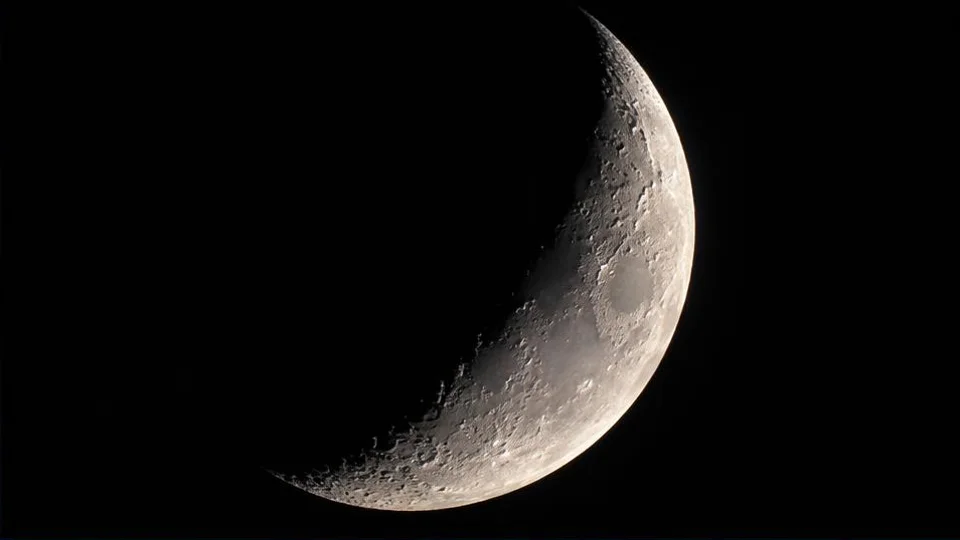
The Moon lacks a substantial atmosphere capable of scattering sunlight throughout the sky as Earth's does. A sunlit surface and a dark surrounding sky can therefore coexist. Exposure settings also affect how stars appear in photographs.
Is blue light moving more slowly through the sky?
The blue color is not caused by blue light being delayed until it accumulates overhead. It results primarily from wavelength-dependent scattering. Light's interactions with materials involve several effects, but they should not be confused with this explanation.
Can a blue sky tell you whether ultraviolet levels are safe?
No. Visible appearance is not a reliable ultraviolet safety gauge. UV exposure depends on factors such as solar angle, altitude, ozone, and cloud conditions. A sky's shade of blue does not replace an appropriate UV forecast.
What to remember
A blue sky is sunlight redistributed by air. Shorter visible wavelengths scatter more strongly, while atmospheric path length, particles, and human vision shape the final color. The same framework connects the blue overhead with pale horizons, white clouds, and warm sunsets.
Sources and further reading

Written by
FactNest Editorial Team
FactNest is operated by Muonix. The FactNest Editorial Team publishes general-interest explainers with AI-assisted drafting and illustrations. Contact contact@muonix.co for questions or corrections; we respond within 2 business days.
More from this author →