The Olympic Games began as a religious gathering at a Greek sanctuary, not as a global championship waiting to happen. Their history connects worship, civic rivalry, changing ideas about participation, and the practical work of organizing international sport. Yet the ancient and modern Olympics are not the same institution stretched across time. Understanding the differences makes familiar features—medals, national teams, ceremonies, and the flame—more meaningful. It also explains why the Games can celebrate shared rules while remaining entangled with the politics of their age.
Key takeaways
- The ancient Games honored Zeus at Olympia; 776 BCE is their first recorded date, not a proven starting point.
- Ancient participation reflected social and religious restrictions, rather than modern ideals of international inclusion.
- The modern Olympics were deliberately created after a long historical break, with the IOC established in 1894.
- Familiar traditions have different origins: the modern torch relay began in 1936, not in ancient Greece.
Olympia: a sanctuary before a sporting stage
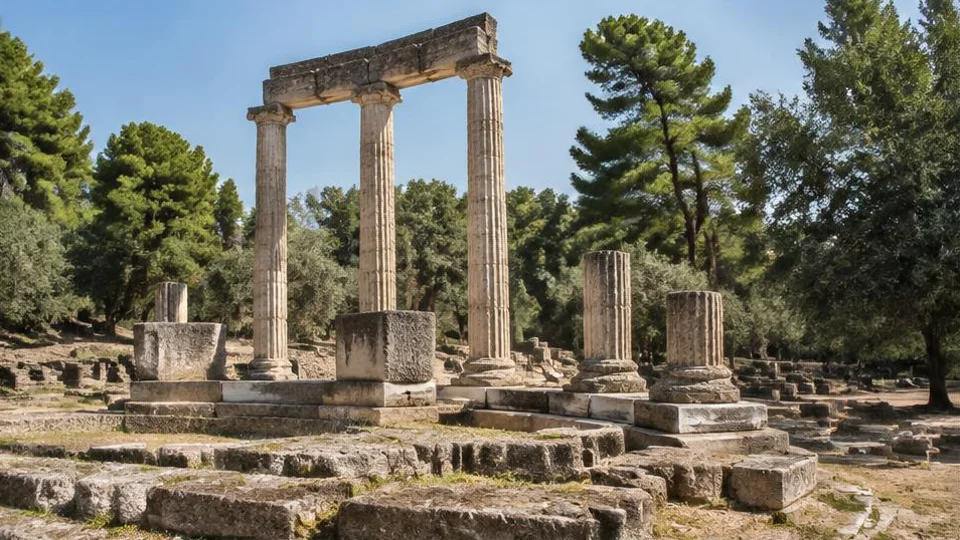
Olympia, in Greece, was a religious sanctuary where the Olympic festival honored Zeus. Athletic contests belonged within that sacred setting. Worship and competition were connected activities, rather than separate programs accidentally sharing a venue. Athletes sought victory before spectators, but their performances also formed part of a festival with religious meaning.
The date 776 BCE marks the earliest recorded Olympic Games. That distinction matters: a surviving record establishes that an event was remembered, not necessarily that nobody had held something similar before it. Treating this date as an unquestionable founding moment asks the evidence to prove more than it can.
What an Olympiad meant
The festival took place every four years. An Olympiad was the interval associated with that cycle, and it became a way of reckoning time. The word therefore refers to more than the days of competition. This regular rhythm helped make Olympia a recurring reference point across a politically divided Greek world.
Who competed, and what victory meant
Ancient Olympic competition was not open to everyone on equal terms. Eligibility reflected Greek identity, sex, legal status, and the conventions of the period. The principal athletic contests were associated with free Greek men, although rules and circumstances changed across the Games’ long history. Calling the ancient Olympics a universal gathering would erase those boundaries.
Events included running, combat sports, and equestrian competition. These were not simply today’s disciplines performed without modern equipment: rules, competitive expectations, and social meanings differed. In equestrian events, the distinction between the person performing and the owner credited with victory could also complicate who counted as an Olympic winner.
Glory beyond the contest
Victory carried prestige for competitors and their communities. The festival prize was not a modern medal, but success could bring recognition and rewards at home. This helps explain the intensity of rivalry: athletic achievement could enhance a city’s standing as well as an individual’s reputation.
How the ancient festival disappeared
The ancient Olympics continued into the Roman period, operating within a world very different from that of their earliest records. Their eventual disappearance belongs to the wider transformation of religious practice, public institutions, and patronage in late antiquity. A festival depended on people, money, facilities, and accepted reasons for gathering; weakening those supports threatened its survival.
It is tempting to give the Games a single, tidy closing date and attribute everything to one imperial decision. The late Roman details are debated, however, and the evidence does not justify presenting every element of that story as settled. Changing attitudes toward traditional worship are important context, not permission to invent a perfectly documented final ceremony.
The essential distinction is clearer than the precise ending: the ancient festival ceased, and there was a long break before the modern Olympics. No uninterrupted organizing body carried the event from Olympia into the present. What survived was memory, material evidence, and an influential cultural ideal.
Building a modern international Olympics
The modern revival grew from interest in antiquity alongside newer ideas about education, organized athletics, and international exchange. Pierre de Coubertin became a leading advocate, but the Games were not the achievement of a lone inventor. Supporters, sporting organizations, and hosts had to turn an attractive proposal into a workable event.
The International Olympic Committee was established in 1894, and Athens hosted the modern Games in 1896. Choosing Greece provided a powerful historical connection. It did not make the new competition an institutional continuation of the ancient festival.
A different organizing principle
Modern organizers needed shared rules, agreed events, and arrangements for competitors arriving from different places. Over time, national Olympic committees and international sporting federations became central to this structure. The result was an international sporting system rather than a sanctuary festival.
National identities consequently became highly visible. Readers interested in that wider setting can explore facts about different countries and their distinctive identities, while remembering that sporting delegations do not map every political complexity neatly.
Expanding participation and the sporting program
Women first competed in the modern Olympics in 1900. This was an opening, not instant equality: access remained limited, and the range of opportunities expanded gradually. The difference matters because a milestone can mark the beginning of institutional change without showing that the change was complete.
The Winter Olympics began at Chamonix in 1924, giving snow and ice sports their own Olympic setting. Expansion required more than adding event names. Different sports demanded suitable venues, specialist officials, equipment standards, and workable competition schedules.
Technology also changed how performances were measured and how distant audiences experienced the Games. Timing systems and broadcasting illustrate why sporting history belongs partly within the history of the world’s most popular inventions: tools influence what organizers can compare, record, and share.
Yet growth creates choices. Every added discipline brings demands for space, expertise, and time. The Olympic program is therefore a constructed selection of sports, not an inevitable catalogue of everything people might compete in.
Ceremonies, politics, and interrupted Games
Olympic ceremonies often blend references to antiquity with modern inventions. The torch relay is a particularly important example: the modern relay began in 1936 in the politically charged setting of the Berlin Games under Nazi rule. Its ancient-looking imagery should not be mistaken for evidence that runners carried the same relay between ancient host cities.
An illustrative viewing check
Imagine watching a runner enter a stadium with a flame. Separate the symbol from the procedure: fire can evoke ancient religious associations, while the organized relay belongs to modern history. Then ask who designed the ceremony and what message it conveys. This approach makes spectacle easier to interpret without dismissing its emotional appeal.
Politics and crisis also affect whether competition happens at all. The Games were interrupted in 1916, 1940, and 1944 by world wars. Tokyo 2020 was held in 2021 after a pandemic postponement. Cancellation and postponement are different outcomes, but both show that the Olympic calendar depends on circumstances beyond sport.
Frequently asked questions
Did the Olympic Games definitely begin in 776 BCE?
No. That is the first recorded date conventionally used for the ancient Olympics, not proof of the festival’s absolute beginning. Earlier activity may not have left comparable evidence. The safest wording is “first recorded in 776 BCE,” which preserves the useful historical landmark without treating the surviving record as a complete account of origins.
Were the ancient Olympics as international as the modern Games?
Not in the modern sense. The ancient festival brought together competitors from the Greek world, within restrictive ideas about eligibility and belonging. Modern Olympics operate through an international sporting structure with much broader participation. Both could connect separate communities, but that similarity should not obscure their different social boundaries and political settings.
Is the Olympic torch relay an ancient tradition?
The modern Olympic torch relay began in 1936. It draws symbolic power from associations between flame, ritual, and antiquity, but that does not make its route-based ceremony an ancient Olympic practice. Its introduction at the Berlin Games also matters: the relay’s history includes deliberate political staging, not merely a neutral tribute to Greece.
Why are the ancient and modern Games treated as connected?
The connection rests on conscious inspiration: the Olympic name, a recurring cycle, athletic excellence, and references to Greece. Modern organizers used that inheritance to give a new international event meaning and prestige. The connection is real as cultural history, but it does not establish uninterrupted administration, identical rules, or unchanged purposes across the historical gap.
Reading the Olympics through their layers
The most revealing question is not whether the Olympics are ancient or modern, but which parts belong to which history. Olympia supplies the religious and athletic inheritance; modern institutions supply today’s competitive framework. Keeping those layers distinct lets us appreciate the spectacle while recognizing the decisions, exclusions, and reinventions behind it.
Sources and further reading

Written by
FactNest Editorial Team
FactNest is operated by Muonix. The FactNest Editorial Team publishes general-interest explainers with AI-assisted drafting and illustrations. Contact contact@muonix.co for questions or corrections; we respond within 2 business days.
More from this author →