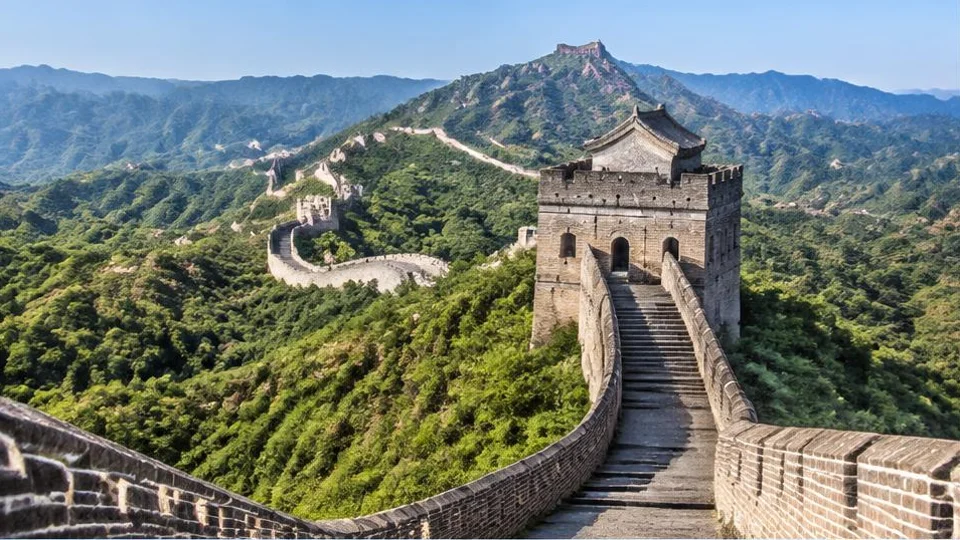
The Great Wall is easiest to misunderstand when viewed as a single object: a ribbon of masonry built once, then left across northern China. It is better understood as a changing system of frontier defenses. Different states and dynasties built barriers where they needed them, using available materials and adapting earlier work. The famous brick battlements belong mainly to the Ming period, but the larger story includes much older earthworks. Understanding how these defenses were built means looking at terrain, labor, supplies, and the people stationed along them.
Key takeaways
- The Great Wall is not one continuous wall from one era. It includes separate lines, branches, rebuilt sections, and associated defenses.
- Builders used local earth, stone, and brick; the surviving appearance depends on both construction methods and later weathering.
- Walls worked with watchtowers, signals, garrisons, and routes for moving people and supplies.
- When comparing wall sections or length estimates, ask which periods, structures, and surveyed remains are included.
A project repeatedly redefined by rulers
Regional states built fortifications before Qin unification. These barriers served their own strategic needs, so they did not begin as pieces of a single national design. Around 220 BCE, the Qin connected and extended earlier defenses, making existing work part of a broader frontier strategy.
That distinction matters: connecting defenses did not mean creating the familiar brick wall seen in modern travel photographs. Earlier builders relied heavily on earth and locally available materials. Later dynasties repaired, replaced, extended, or abandoned defenses as political boundaries and military priorities changed.
Why the Ming wall looks familiar
The Ming dynasty, which ruled from 1368 to 1644, undertook extensive defensive construction. Much of the iconic surviving brick-and-stone architecture belongs to this period, although not every Ming section used the same materials or design.
Dating a particular stretch therefore requires evidence about that stretch. Its location within “the Great Wall” does not establish when its visible masonry was built, or whether older work lies beneath it.
Letting the landscape shape the route
A wall route was a practical compromise, not simply a line drawn across a map. Ridges could provide commanding views and difficult approaches, while passes required particular attention because they offered more convenient routes through mountains. Valleys and flatter country presented different construction and surveillance problems.
Following high ground could improve defensive visibility, but it also made construction harder. Workers needed to prepare stable bases on uneven terrain and bring materials to places where ordinary transport was difficult. A route that looked strong militarily could be expensive to build and supply.
Terrain was part of the defense
Builders could use steep slopes and other natural obstacles alongside constructed barriers. The result was not uniform engineering repeated without regard to place. Wall height, alignment, and construction could respond to local ground conditions and strategic importance.
The useful question is therefore not merely “Why does the wall bend here?” but “What approach, crossing, or view did this position help control?”
Turning earth, stone, and brick into barriers
Construction began with what builders could obtain and move. Earth was not simply heaped into a loose mound. In rammed-earth work, material was placed in layers within temporary formwork and compacted repeatedly. Compression made a denser mass; successive layers built up the barrier. Material selection and workmanship affected how well it endured.
Stone offered another solution where suitable rock was available. It could provide foundations, retaining faces, or substantial walling. Brick allowed builders to create more regular masonry surfaces, but it required a supply chain: suitable raw material, shaping, firing, fuel, and transport.
The outside was not necessarily the inside
A masonry-faced wall need not be solid cut stone or brick throughout. Some sections used outer faces around an internal core of earth and rubble. The facing contained and protected the interior, while the core supplied bulk.
Water management mattered too. If water entered damaged masonry or washed away supporting earth, a strong-looking wall could deteriorate from within. Surviving construction reflects maintenance as well as the original build.
Organizing people and moving supplies
Building the wall required more than masonry skills. Someone had to choose routes, organize work, obtain materials, provision workers, and keep construction moving. Soldiers, conscripted laborers, and prisoners participated in different historical settings; their roles and conditions varied across periods and locations.
The human cost should not be hidden behind admiration for the architecture. Compulsory labor could place severe burdens on workers and communities. At the same time, sweeping claims about precise death totals or universal burial practices go beyond what the supplied evidence establishes.
Transport was a central constraint. Earth obtained nearby required less hauling than masonry brought from farther away. Brick production shifted some work to kilns, but finished bricks still had to reach the building site. Food, water, tools, and replacement equipment also needed dependable delivery.
This helps explain why “How was it built?” has no single technological answer. Construction depended on organizing many ordinary tasks under difficult conditions, repeatedly and over long periods.
Making a wall function as a defensive system
A barrier alone could not watch an entire frontier or decide how to respond to an approaching force. Watchtowers supplied observation points, while signaling helped carry warnings between positions. Garrisons provided the people who watched, maintained defenses, controlled crossings, and responded to threats.
Roads and movement routes were equally important. A warning had limited value unless troops and supplies could reach the relevant area. Passes and gates also made the frontier selective rather than simply sealed: authorities could supervise movement through designated points.
Delay and coordination, not invulnerability
The wall could obstruct movement, channel approaches, and buy time. Its effectiveness still depended on staffing, communication, supplies, leadership, and the wider military situation. An impressive barrier without those supporting arrangements was not an impenetrable shield.
For readers exploring historical mysteries that still fascinate researchers, the useful habit is to separate uncertain details from well-established mechanisms. The Great Wall's construction is not inexplicable; the harder questions often concern particular sites, phases, and decisions.
Reading the evidence in a surviving section
A visit or photograph becomes more informative when you look beyond the outline. Notice whether the visible surface is earth, irregular stone, or regular brick. Look for changes in alignment, masonry, and preservation, but do not assume each change marks a different dynasty. Repairs, erosion, and restoration can also alter appearances.
An illustrative comparison
Imagine an exposed earthen ridge beside a neatly faced masonry section. This is an illustrative example, not a description of a named site. The masonry might represent different construction, later rebuilding, or modern restoration. Appearance alone cannot decide between those explanations; site records and archaeological evidence are needed.
The same caution applies to lengths. An inventory that counts branches and associated remains answers a different question from a measurement of one surviving wall line. As with other fascinating facts about different countries, a memorable claim becomes more useful when its definition travels with it.
Frequently asked questions
Who originally built the Great Wall?
There was no single original builder. Regional states constructed fortifications before Qin unification. Around 220 BCE, the Qin connected and extended earlier defenses. Subsequent dynasties undertook their own work, and the Ming built much of the familiar surviving masonry. The answer depends on which wall section and construction phase you mean.
Was the Great Wall made entirely of brick?
No. Builders used packed earth, stone, and brick in combinations suited to local resources and requirements. Some masonry sections had outer faces surrounding an earth-and-rubble core. Brick battlements dominate popular images, but they do not represent every period or landscape. Weathered earthworks are also important parts of the wall's history.
Did the wall completely prevent invasions?
No defensive wall could guarantee that outcome. These barriers helped obstruct and channel movement, while towers, signals, garrisons, and routes supported observation and response. Their usefulness depended on the people and institutions operating them. Border control and military coordination are better ways to understand the system than assuming it created an uncrossable boundary.
Can you see the Great Wall from the Moon?
No, it is not visible unaided from the Moon. Its enormous overall extent does not make its individual sections wide enough to stand out at that distance. The popular claim confuses length with visibility. The wall's real achievement lies in its construction and organization across difficult terrain, not this viewing myth.
Seeing construction rather than a single monument
The Great Wall becomes more understandable when each stretch is treated as a local engineering solution within a changing frontier system. Ask what it was made from, why it followed that route, and how people supplied and operated it. Those questions reveal more than imagining one uninterrupted construction campaign.
Sources and further reading

Written by
FactNest Editorial Team
FactNest is operated by Muonix. The FactNest Editorial Team publishes general-interest explainers with AI-assisted drafting and illustrations. Contact contact@muonix.co for questions or corrections; we respond within 2 business days.
More from this author →