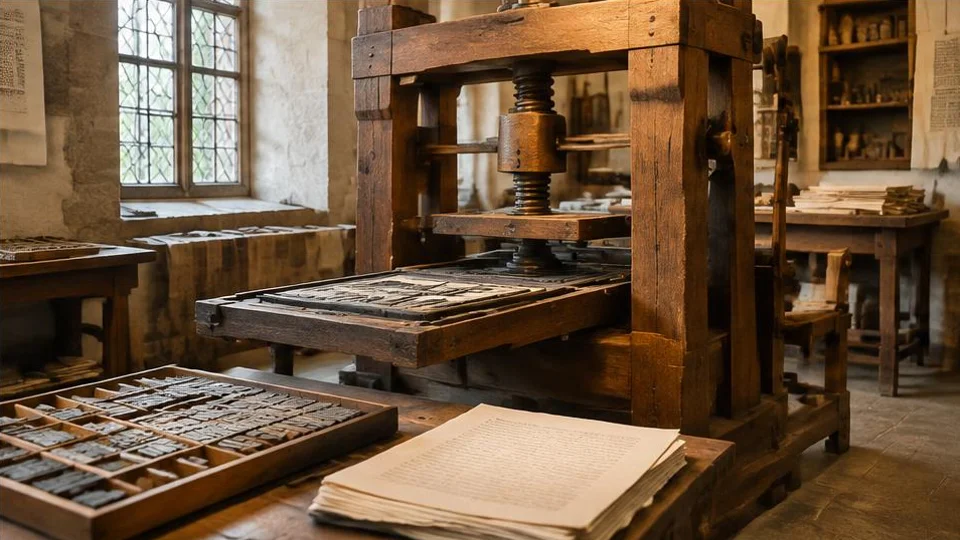
A printing press looks like a machine with a clear inventor: someone builds it, turns a handle, and changes the world. The history is less tidy—and more revealing. Printing depended on several distinct developments, including carved blocks, reusable characters, suitable ink, paper handling, and organized workshop labor. East Asian printers worked with blocks and movable type before Johannes Gutenberg’s workshop in Mainz. Understanding what Gutenberg contributed means separating the idea of reproducing text from the practical system that made particular kinds of reproduction effective.
Key takeaways
- Printing, movable type, and the mechanical press are related technologies, not interchangeable names for one invention.
- East Asian woodblock printing and movable type preceded Gutenberg; his contribution was a coordinated European production system.
- Reusable type saved some work but required composition, proof correction, and careful handling.
- More available copies did not automatically mean universal literacy, equal access, or lower costs for every printing job.
Before the press: printing from blocks
Woodblock printing begins with a surface carrying a reversed design. A carver removes the areas that should remain blank, leaving characters or images raised. Ink goes onto those raised surfaces, and contact with paper transfers the design. The printed impression reads the right way around.
This approach was established in East Asia before Gutenberg. It could reproduce an entire page without requiring someone to copy the text by hand each time. Once prepared, a block could be kept and used again, although carving it demanded skill and effort.
A page as a reusable object
A woodblock preserved the page’s arrangement along with its words. That was useful when a text needed further impressions without being redesigned. Lettering and pictures could also occupy the same carved surface.
The limitation was different from movable type’s: characters remained part of that particular block. They could not simply be lifted out and rearranged to print an unrelated page. Neither approach was automatically superior for every task.
Movable type was already an East Asian idea
Movable type separates a page into reusable printing elements. Instead of carving the whole page as one object, a printer assembles individual characters, prints from them, and later rearranges them. The important conceptual change is that the printing surface becomes temporary while its components remain useful.
Bi Sheng developed ceramic movable type in China in the eleventh century. Korean printers used metal movable type before its development in Europe. These precedents rule out the familiar claim that Gutenberg invented either printing itself or the general principle of movable type.
Why materials and scripts mattered
Ceramic and metal presented different problems of manufacture, durability, and handling. A printer also needed a way to keep characters aligned and secure during printing.
Writing systems influenced the work. A large character inventory required different storage and retrieval arrangements from an alphabetic system. That distinction affected workshop choices; it does not establish a hierarchy of cultures or make woodblock printing an obsolete mistake. Printers had to match tools to the texts they produced.
What Gutenberg brought together in Mainz
Gutenberg’s achievement in mid-fifteenth-century Mainz was a practical combination of cast metal type, suitable ink, a press, and coordinated production. Calling this a system is more precise than crediting him with an isolated machine. Reusable letters were valuable only if they could be made consistently, arranged securely, inked properly, and impressed onto paper.
Casting allowed printers to produce many individual pieces of type. Their printing faces needed to work together at a consistent height. Ink had to adhere to those faces and transfer effectively, while pressure had to bring paper into controlled contact with the assembled surface.
Gutenberg’s forty-two-line Bible, produced in the mid-1450s, demonstrates the system’s capacity for sustained book production. Its significance lies not merely in the existence of printed letters, but in the coordination needed to produce a substantial work.
Like other major inventions and the developments behind them, this technology makes more sense when we ask which problems were solved together, rather than searching for a single miraculous moment.
How a page moved through the workshop
A compositor selected individual pieces of type and assembled them into lines. Spaces and other nonprinting material helped establish the layout. The resulting pages had to be secured so that the pieces would not shift under the forces of inking and printing.
The printing surfaces were inked, paper was positioned, and the press applied pressure. Pulling an impression was therefore only part of the work. Preparing the type and managing sheets were essential to making that action useful.
Proofs, corrections, and resetting
A proof gave the workshop a chance to inspect the result. A wrong character, missing word, or spacing problem could require changes to the assembled type. Correction was not automatic: someone had to notice the problem and alter the printing surface.
After a job, type could be distributed back into storage. Printing another text required fresh composition. Reprinting an earlier text might also require resetting if its type had already been reused. Movable type preserved reusable parts, not necessarily a permanently assembled page.
When printing saved work—and when it did not
Printing shifted much of the effort toward preparation. Making a printing surface took time, but that surface could produce repeated impressions. This helps explain why printing expanded the supply of copies without making every individual job inexpensive.
Illustrative example: imagine a workshop asked for ten copies of a short notice, then another order for a thousand copies of the same notice. Both orders require composition and checking. In the larger order, that preparation serves many more sheets. But paper, ink, presswork, and handling still increase as more copies are produced. These quantities are hypothetical, not historical prices or output figures.
The comparison also clarifies why the cheapest method depended on the job. Length, layout, desired quantity, corrections, and available equipment could change the balance.
Distribution added another practical limit. Finished sheets still had to reach readers, and books might require further assembly and binding. A productive workshop was not the same thing as an effective network for selling and transporting its output.
More copies did not mean equal access
Printing made it possible to reproduce texts in larger quantities, but availability and accessibility are different things. A person still needed access to a copy, knowledge of its language, and the ability or opportunity to read it. Education and purchasing power did not spread automatically with presses.
Nor did identical-looking pages guarantee reliable information. Printing could repeat a carefully checked text or reproduce an error across many copies. Proofreading mattered precisely because reproduction amplified whatever remained on the printing surface.
Evidence is not an origin legend
The surviving record also needs careful interpretation. An early surviving printed object demonstrates that a technique existed by that point; it does not necessarily identify its first use. Conversely, an attractive story about transmission is not proof of a specific route between workshops or regions.
As with unresolved historical questions and the evidence behind them, the useful distinction is between established precedents and details that remain uncertain. Recognizing East Asian priority does not require inventing a documented chain of instruction to Mainz.
Frequently asked questions
Did Gutenberg invent printing?
No. East Asian woodblock printing and movable type preceded his work. Gutenberg’s distinctive achievement was developing a practical European system combining cast type, ink, a press, and workshop organization. Describing that contribution accurately gives him credit without erasing earlier printers or confusing printing with one particular method of production.
How is movable type different from a printing press?
Movable type is the reusable material arranged to form a printing surface. A press is a mechanism that applies pressure to transfer an inked impression. They perform different functions. Type needs preparation and securing before printing, while block printing shows that reproducing a page does not inherently require assembling separate characters.
Did printed books immediately become cheap?
Not necessarily. Preparing type and correcting proofs required labor, and each additional copy still consumed materials and press time. Larger print runs could spread preparation costs across more copies, but affordability depended on the job and the reader’s resources. Printing increased reproductive capacity without instantly removing the costs of making and distributing books.
How can I recognize different printing methods?
Begin by asking how the printing surface was made: carved as a whole, or assembled from reusable pieces? In a museum, a displayed block or type arrangement may answer that more clearly than the finished page. Appearance alone can mislead, so use object labels and catalog descriptions rather than assuming all old printed pages used movable type.
Look beyond the handle
The history of printing becomes clearer when the press is treated as part of a workshop rather than a solitary invention. Blocks, characters, ink, pressure, correction, and distribution each solved different problems. Together, they explain both printing’s extraordinary reach and the work that remained behind every reproduced page.
Sources and further reading

Written by
FactNest Editorial Team
FactNest is operated by Muonix. The FactNest Editorial Team publishes general-interest explainers with AI-assisted drafting and illustrations. Contact contact@muonix.co for questions or corrections; we respond within 2 business days.
More from this author →