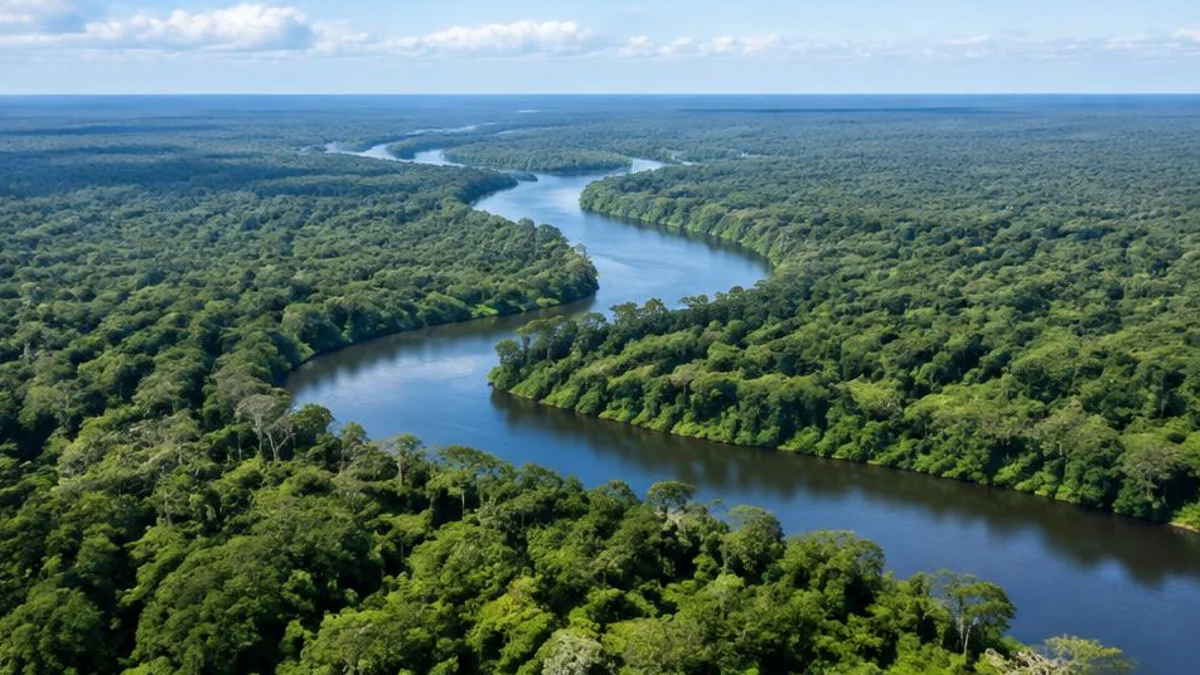
The Amazon rainforest is one of the best-known natural places on Earth, and also one of the most surrounded by half-true claims. You may have heard that it produces a fifth of the world's oxygen, that it is an untouched wilderness, or that it will collapse on a particular date. Each of these contains a grain of truth wrapped in a simplification. The real Amazon is a vast, varied and inhabited region, and the most accurate facts about it are often more interesting than the slogans.
This article sticks to well-supported points and flags where the science is still developing or where numbers vary depending on how the Amazon is defined.
Key takeaways
- "The Amazon" can mean the river, its drainage basin or the rainforest, and these have different boundaries.
- The Amazon is a mosaic of habitats, including forests that flood seasonally, forests on higher ground and other ecosystems, not one uniform jungle.
- It is extraordinarily rich in species, but quoting exact percentages or species totals without a clear source is unreliable.
- People have lived in the Amazon for thousands of years. It is not an empty wilderness, and Indigenous communities remain important to its future.
- Forests influence rainfall by releasing water vapour, a process called transpiration.
- Whether a forest absorbs or releases carbon depends on the balance between growth and processes such as respiration, decay and fire. It varies by place and over time.
- The claim that the Amazon produces 20 percent of the world's oxygen is an oversimplification.
- Deforestation and fire matter, but predicting a precise "tipping point" date is not something the evidence supports.
What do we mean by "the Amazon"?
Three related things share the name:
- The Amazon River, one of the world's largest rivers by water volume.
- The Amazon basin, the huge area of land drained by the river and its tributaries, spread across several countries.
- The Amazon rainforest, the forest ecosystems that cover much of that basin.
Not all of the basin is rainforest. It includes other kinds of vegetation too, and the borders of the rainforest depend on how scientists and governments define them. This is one reason numbers for the Amazon's "size" differ between sources. When you see a figure, check what area it describes.
A mosaic, not a single jungle
Photographs often show an unbroken green canopy, but the Amazon contains many different environments:
- Terra firme forest, growing on higher ground that does not flood.
- Seasonally flooded forests, where rivers rise and cover the forest floor for part of the year. Different rivers have different water chemistry, which affects the type of flooded forest.
- Savannas, grasslands and other open habitats in parts of the wider region.
- Rivers, lakes and wetlands that support their own communities of plants and animals.
This variety is one reason the region supports such an enormous number of species. Different habitats favour different plants, which in turn support different insects, birds, fish and mammals.
Biodiversity: rich, but be careful with numbers
The Amazon is famous for its biodiversity, and with good reason. It is home to a huge variety of plants, insects, fish, birds, amphibians, reptiles and mammals, and scientists keep describing new species. Statements such as "the Amazon contains X percent of all the world's species" circulate widely, but they are rarely backed by a clear source, because nobody has a complete inventory of life on Earth. A safe way to put it is that the Amazon is among the most biodiverse regions known and that research continues to discover more.
People have lived in the Amazon for thousands of years
A common image is of the Amazon as a pristine wilderness, untouched by people until recently. The evidence points in a different direction. Indigenous peoples have lived in the Amazon for thousands of years, in many distinct communities with their own languages and cultures, and many continue to do so today.
How strongly people shaped the forest in the past is an active area of research, and the answer appears to vary from place to place. For example, a 2021 study reported by the Smithsonian examined records from the western Amazon and found evidence that prehistoric Indigenous peoples there did not significantly alter large areas of forest, and that their use of the land was sustained over a very long period. Other parts of the Amazon show different patterns, and scientists are still piecing together the picture. What is clear is that "empty wilderness" is not an accurate description, and that Indigenous knowledge and land rights are central to conversations about the forest's future.
Forests and rainfall
Trees take up water from the soil through their roots and release water vapour through their leaves, a process called transpiration. In a large forest, this adds a great deal of moisture to the air. Scientists describe this as part of the way the forest and the regional climate are linked: some of the rain that falls in the basin comes from moisture that the forest itself helped return to the atmosphere, in addition to moisture carried in from the ocean.
The exact size of this effect, and how it varies between regions and seasons, is a subject of ongoing research. It does help explain why researchers worry about how large-scale clearing might affect local and regional rainfall.
Carbon: more complicated than "lungs of the Earth"
Growing trees absorb carbon dioxide from the air through photosynthesis and store carbon in their wood, roots and soils. That is why forests are often called carbon stores. But forests also release carbon dioxide through respiration by plants and microbes, through the decay of dead material and through fires.
Whether a particular patch of forest is a net absorber or a net source of carbon depends on how these processes balance and can change from year to year and place to place. Drought, fire and clearing can shift an area toward releasing carbon. Because the balance is not fixed, it is more accurate to say that the Amazon holds a very large amount of carbon, and that its future role depends on what happens to the forest, than to say it will always absorb a particular amount.
Does the Amazon produce 20 percent of the world's oxygen?
This claim is very popular, but it is an oversimplification. Through photosynthesis, plants release oxygen. But the same forest also uses oxygen when plants breathe and when dead plants and animals decay, and in a mature ecosystem these roughly balance out. As a result, the Amazon is not a large net supplier of the oxygen we breathe, and the atmosphere's oxygen supply is not at risk from the loss of a forest in the way the slogan suggests. That does not make the forest unimportant: it matters for biodiversity, water cycles, carbon storage, Indigenous livelihoods and much more. It simply means this particular statistic is not a good reason to protect it.
Deforestation, fire and "tipping points"
Clearing and burning forest for farming, ranching, roads and other uses have changed parts of the Amazon. Effects include loss of habitat, changes in local climate, emissions of carbon dioxide and more fragmented forest that can dry out and burn more easily. The scale and pace of change vary by country, region and year, and policies and enforcement affect the trends.
Scientists have discussed the idea of a tipping point, a threshold beyond which large areas of forest might shift toward a drier, savanna-like state. This is a real topic of research, but the evidence does not support a specific date or a single number at which it will happen. The responsible position is that the risk is taken seriously and that the details remain uncertain.
Frequently asked questions
Is the Amazon the same as the Amazon River?
No. The river, its drainage basin and the rainforest are related but not identical, and they have different boundaries.
Does the Amazon produce 20 percent of the world's oxygen?
No, that claim is an oversimplification. The forest produces oxygen by photosynthesis but also uses it through respiration and decay, so it is not a large net oxygen supplier.
Is the Amazon an untouched wilderness?
No. People have lived there for thousands of years, and many Indigenous communities live there today. How much people shaped the forest in the past varies by region.
Does the Amazon always absorb carbon?
Not always. Whether it absorbs or releases carbon depends on growth, respiration, decay and fire, and it varies by place and over time.
Will the Amazon collapse on a certain date?
The evidence does not support a precise date. Scientists study the risk of tipping points but cannot say exactly when or whether one will be crossed.
Sources and further reading
- Mapping the Amazon (NASA Earth Observatory)
- Indigenous peoples were stewards of the western Amazon (Smithsonian Institution)
Related reading on FactNest: How plants communicate with each other and Amazing facts about the deep ocean.

Written by
FactNest Editorial Team
FactNest is operated by Muonix. The FactNest Editorial Team publishes general-interest explainers with AI-assisted drafting and illustrations. Contact contact@muonix.co for questions or corrections; we respond within 2 business days.
More from this author →