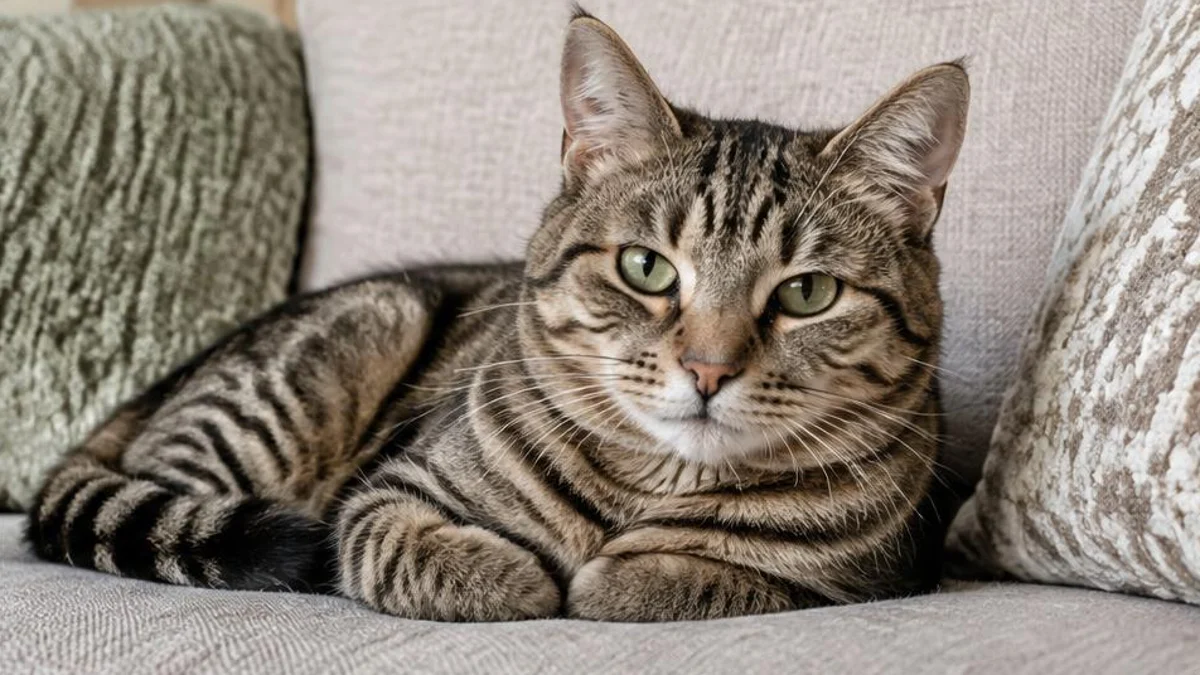
A purring cat on your lap is one of the most familiar sounds in many homes. Most people take it to mean "I'm happy," and often that is a reasonable guess. But the full story is more interesting. Scientists are still working out exactly how cats produce the sound, and purring does not always mean contentment. Understanding what is known, and what is not, helps you read your cat better and avoid some popular myths.
This article is general information about cat behaviour and biology. It is not veterinary advice and cannot diagnose or treat any health or behaviour problem. If you are worried about your cat, speak to a veterinarian.
Key takeaways
- A purr is a low, rhythmic, continuous sound that cats can make while breathing in and out.
- A 2023 study found that the larynges of domestic cats, removed after death, could produce purr-like frequencies without any nerve signals. This shows what the tissue is capable of, but it does not fully settle how living cats purr.
- Researchers have suggested that soft tissue in the vocal folds may help produce very low frequencies, and that muscles may still play a role.
- Cats purr in many situations: when relaxed, when seeking attention or food, and sometimes when stressed or unwell. Purring alone is not proof of happiness.
- Body language and context give better clues than the sound by itself.
- There is no solid evidence for popular claims that purring heals bones or other conditions in people or cats.
- Cat sounds are a form of communication, but they are not a language in the human sense.
What a purr is
A purr is a soft, continuous, vibrating sound, usually described as low and steady. Unlike a meow, which a cat makes as it breathes out, a purr can continue through both the in-breath and the out-breath, which is why it can seem unbroken. The sound is produced in the larynx, or voice box, the same general area that produces other cat vocalisations.
Domestic cats are known for purring, and several other cat species purr as well. The details differ across species, and researchers continue to compare them.
How do cats produce the sound?
For decades, the standard explanation was that a cat's brain sends rapid, rhythmic signals to the muscles of the larynx, making the vocal folds twitch open and closed at a very high rate, creating the purr. This is sometimes called the active muscle contraction model. The idea has been widely repeated, but it has been tested less directly than many people assume.
In 2023, researchers led by Christian Herbst and colleagues published a study in the journal Current Biology. They worked with the larynges of eight domestic cats, removed after death, and passed air through them in a laboratory setup. All of the larynges produced sounds in the purring range, around 25 to 30 vibrations per second, without any nerve signals or muscle contractions.
What does this tell us? It shows that the physical structure of a cat's larynx can vibrate at purring frequencies on its own when air flows through it. That is an important result, because it challenges the idea that purring requires a special neural pacemaker in the brain.
What the study does not show
The authors were careful about the limits of their work, and it is worth repeating them:
- The experiment used removed larynges, not living cats. It shows what the tissue can do under certain conditions, not exactly what happens inside a living animal.
- The results do not rule out a role for muscle control in living cats. Muscles may still help to start, stop or adjust purring.
- The researchers proposed that connective tissue within the vocal folds, small soft pads, may help the folds vibrate at the very low frequencies seen in purring. This is a hypothesis supported by their observations, not a closed case.
In short, scientists have learned more about what the larynx can do, but the complete explanation of how living cats purr is still being worked out.
When do cats purr?
It is tempting to treat purring as a simple happiness signal, but cats purr in a range of circumstances:
- Relaxation and contentment, such as when being stroked or settling down to rest.
- Seeking attention or food. Some cats purr when they want something from a person, and some research suggests that cats can adjust their purring to get a response from the people they live with.
- Social situations, such as kittens purring while nursing and mother cats purring in return.
- Stress, fear or discomfort. Some cats purr when they are anxious, frightened, in pain or unwell. Veterinary sources describe this possibility, and it is one reason why purring should not be used as the only sign of how a cat feels.
Because the same sound can occur in very different situations, the purr alone is an unreliable guide to a cat's mood.
Reading the whole cat
A more reliable approach is to look at the context and the cat's body language alongside the sound. Things to notice include:
- Posture: a loose, relaxed body with soft muscles suggests comfort. A tense, crouched or hunched posture does not.
- Ears: upright and relaxed is different from flattened or rotated backwards.
- Tail: a gently held or slowly swishing tail differs from a puffed or rapidly lashing one.
- Eyes: slow blinks and soft eyes are generally relaxed, while wide, fixed pupils may signal arousal or fear.
- Situation: is the cat at home, in a new place, at a vet clinic, or close to mealtime?
If a cat purrs but also hides, avoids touch, stops eating or behaves differently from usual, it is worth talking to a veterinarian, because the cat may be unwell. This article cannot tell you what a particular cat's behaviour means.
The "healing purr" claim
You may have read that purring at certain frequencies promotes healing, or that a cat's purr can mend bones. These claims are repeated often online, but they are not backed up by strong evidence. Some researchers have suggested that low-frequency vibrations might have effects in other contexts, but that is a different matter from claiming that a cat's purr heals people or other animals, and it should not replace professional medical or veterinary care.
The fair statement is that purring is an interesting behaviour whose full function is still being studied. It is best not to make health decisions based on it.
Cat sounds are communication, but not a language
Cats communicate in several ways: sounds, body posture, scent and touch. Researchers have studied how adult cats use vocalisations, especially meows, mostly in their interactions with people. A Cornell University report on this work noted that meowing is not language in the strict sense, but it is clearly a way of communicating with humans, and cats can adapt their sounds to the people they live with. That is a good reminder that cat sounds convey information without being a language with grammar and vocabulary like human speech.
What to take away
The next time your cat purrs, you can enjoy the sound while remembering a few things:
- Scientists have shown that the cat larynx can generate purring frequencies by itself, but the whole mechanism in living cats is not fully settled.
- A purr can mean many things, so look at the whole animal and the situation.
- If you are concerned about your cat's health or behaviour, a veterinarian is the right person to ask.
Frequently asked questions
Why do cats purr?
Cats purr in several situations, including when relaxed, when seeking attention or food, and sometimes when stressed or unwell. The sound has more than one function.
How do cats make the purring sound?
It is produced in the larynx. A 2023 study showed that cat larynges can produce purr-like frequencies without nerve signals, but whether and how muscles are involved in living cats is still being researched.
Does purring always mean a cat is happy?
No. Cats may also purr when they are anxious, in pain or unwell. Check the cat's body language and context.
Can a cat's purr heal bones?
There is no strong evidence for that claim. Purring should not be treated as a medical treatment for people or cats.
Is meowing a language?
Not in the human sense. It is a form of communication, especially toward people, but it does not have the grammar and vocabulary of human languages.
Sources and further reading
- Domestic cat larynges can produce purring frequencies without neural input (Current Biology, 2023)
- It's the cat's meow: not language, strictly speaking, but close enough (Cornell Chronicle)
Related reading on FactNest: 10 fascinating facts about the human brain and Surprising facts about octopuses.

Written by
FactNest Editorial Team
FactNest is operated by Muonix. The FactNest Editorial Team publishes general-interest explainers with AI-assisted drafting and illustrations. Contact contact@muonix.co for questions or corrections; we respond within 2 business days.
More from this author →