If rivers are made of fresh water and they all flow into the sea, why is the sea salty while rivers are not? It is one of the most common questions people ask about the ocean, and the answer involves rain, rock, volcanoes and a long, slow balancing act that has kept seawater remarkably stable. The short version is that rivers are not truly salt-free, they carry small amounts of dissolved minerals to the sea, and the sea has no outlet other than evaporation, which takes water away and leaves the salts behind.
This article is educational. One practical note up front: seawater is not safe to drink, and nothing here is advice about survival or health.
Key takeaways
- Salt in the ocean comes mainly from the weathering of rocks on land and from processes on the seafloor, including hydrothermal vents.
- Rivers carry dissolved minerals to the ocean. They taste fresh because the concentration is very low.
- Sodium and chloride, the ingredients of table salt, make up roughly 85 percent of the dissolved ions in seawater.
- Average ocean salinity is about 35 parts per thousand, but it varies from place to place and over time.
- Evaporation removes water and leaves salts, while rain, river water and melting ice dilute the ocean locally.
- The ocean is not getting endlessly saltier, because processes that add salt are balanced by processes that remove it.
Where the salt comes from
Rocks on land
Rain is naturally slightly acidic because carbon dioxide from the air dissolves in it. When rainwater falls on rocks, it slowly breaks them down, a process called weathering. This releases tiny amounts of minerals as dissolved charged particles called ions. Streams and rivers carry these ions downhill and eventually into the sea.
Rivers are therefore not salt-free. They carry dissolved minerals, but at concentrations so low that the water tastes fresh. Over very long periods of time, the ocean receives a steady supply of these ions.
Vents and volcanoes on the seafloor
The ocean floor also contributes. In places where hot rock lies close to the seabed, seawater seeps into cracks, heats up and reacts with the rock. This hydrothermal circulation changes the chemistry of the water. Some elements are added to the water, and others are taken out of it. The water then returns to the ocean through hydrothermal vents. Undersea volcanic activity can also release substances into the water.
This means the seafloor is not just a source of salts but also part of the system that removes certain ions, which is one reason the overall composition stays fairly steady.
Why sea water is salty but rivers are not
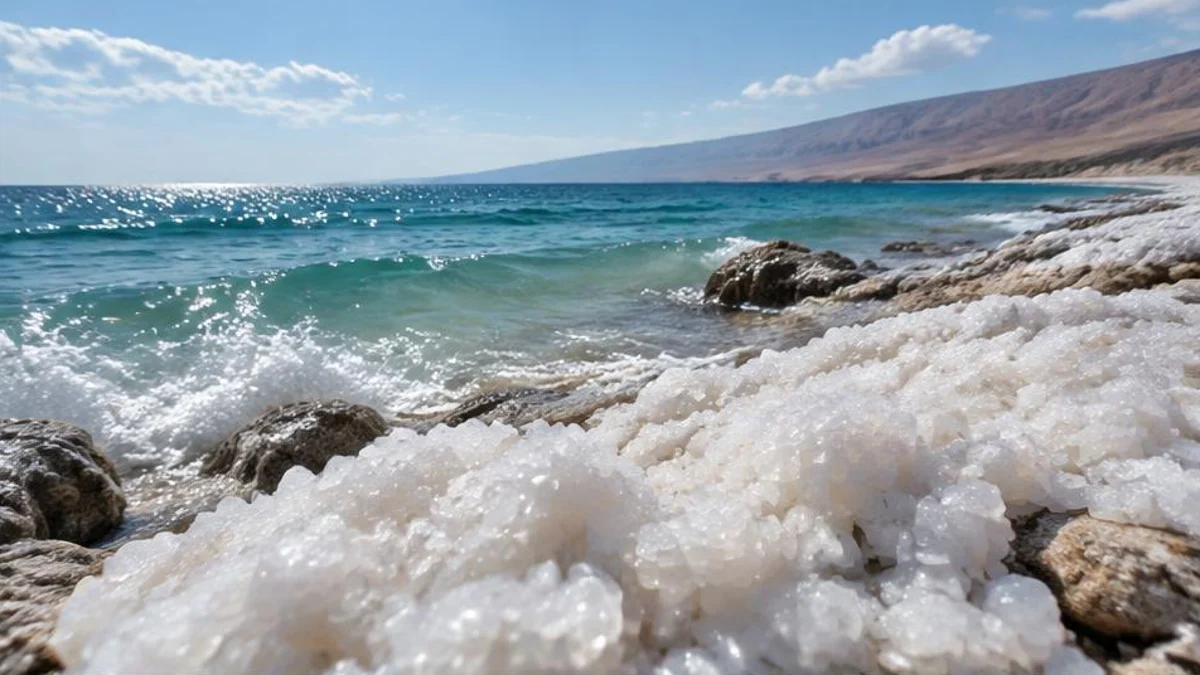
If rivers carry ions into the ocean all the time, why do rivers not taste salty? The key is what happens at the end of the journey. A river flows through the land and into the sea, so its water is constantly replaced. The ocean, by contrast, is a terminal basin: water leaves mainly by evaporation, rising into the air as vapour, but the dissolved ions do not evaporate with it. They stay behind. Over enormous stretches of time, the ions delivered by rivers have accumulated in the sea.
An everyday comparison helps. If you leave a pan of mineral water on a warm windowsill, the water gradually disappears, and a crusty residue of minerals remains. The ocean works on a vastly larger scale, with a continuous supply of new minerals arriving.
What is in the salt
The dissolved material in seawater includes many ions, but a few dominate:
- Chloride and sodium together make up about 85 percent of the dissolved ions, which is why seawater tastes like table salt.
- Sulfate, magnesium, calcium and potassium are also present in smaller but significant amounts.
- Trace amounts of many other elements are dissolved as well.
Scientists describe how salty water is using salinity, often measured in parts per thousand. The average for the open ocean is about 35 parts per thousand, which means roughly 35 grams of dissolved salts in each kilogram of seawater.
Salinity is not the same everywhere
The ocean is not uniformly salty. Several processes raise or lower salinity at the surface:
- Evaporation removes fresh water and increases salinity, especially in warm, dry, sunny regions.
- Rainfall adds fresh water and lowers salinity.
- River water entering the sea dilutes it, which is why salinity is lower near the mouths of large rivers.
- Melting ice adds fresh water and lowers salinity nearby.
- Sea ice formation pushes in the opposite direction. When seawater freezes, most of the salt is left out of the ice, so the water beneath becomes saltier.
Some enclosed bodies of water are much saltier than the open ocean. In places where evaporation is intense and little fresh water arrives, salinity can climb well above the ocean average. Others, such as the Baltic Sea, are much less salty because of river input and limited exchange with the open ocean.
Is the ocean getting saltier?
Because salts accumulate over time, you might expect the ocean to become saltier without limit. It does not, at least on the timescales scientists generally discuss. The ions added by rivers and vents are balanced by processes that remove them. Some ions are taken up into sediments on the seafloor, some are incorporated into marine organisms' shells and skeletons, and some are removed through chemical reactions at vents. The result is a rough balance between inputs and removals, which is part of why the overall salinity has stayed within a fairly narrow range.
It is important not to overstate what is known. Scientists track changes in surface salinity in particular regions, and patterns can shift with rainfall, evaporation and ice melt. Claims about exact current trends should be checked against up-to-date research instead of assumed.
Why you cannot drink seawater
The human body needs to keep the concentration of salts in its fluids within a narrow range. Seawater is much saltier than body fluids, so drinking it forces the body to use more water to get rid of the extra salt than the drink supplies. That is why seawater does not hydrate. For safety, anyone in an emergency at sea should follow guidance from rescue and medical authorities.
Why it matters
Salinity affects more than the taste of seawater. It influences:
- Density: saltier water is denser, which helps drive ocean circulation together with temperature.
- Freezing point: seawater freezes at a lower temperature than fresh water.
- Marine life: many organisms are adapted to a specific range of salinity.
Because salinity responds to evaporation, rain and ice, it also gives scientists a useful clue about the water cycle.
Frequently asked questions
If rivers carry salt to the ocean, why do rivers taste fresh?
Rivers carry only small amounts of dissolved minerals. The ocean accumulates them because water leaves by evaporation but the minerals stay behind.
What is the main salt in the ocean?
Sodium and chloride, the components of table salt, make up about 85 percent of the dissolved ions.
Is the ocean equally salty everywhere?
No. Salinity varies with evaporation, rainfall, river input, ice melt and ice formation. The open-ocean average is about 35 parts per thousand.
Will the ocean keep getting saltier forever?
Processes that remove ions roughly balance those that add them, so the ocean is not expected to become endlessly saltier. Regional changes can still occur.
Can you drink seawater if you boil it?
Boiling does not remove the salt. Safe drinking water from seawater requires desalination, and anyone in a real emergency should follow official guidance.
Sources and further reading
Related reading on FactNest: Amazing facts about the deep ocean and Why is the sky blue?.

Written by
FactNest Editorial Team
FactNest is operated by Muonix. The FactNest Editorial Team publishes general-interest explainers with AI-assisted drafting and illustrations. Contact contact@muonix.co for questions or corrections; we respond within 2 business days.
More from this author →