A volcano can sit quiet for centuries and then change a landscape in a day. Some eruptions are slow rivers of glowing rock that you could outwalk; others are towering clouds of ash and gas that spread across continents. What decides which one you get? The answer lies in what is happening underground: how rock melts, how gas behaves as pressure drops, and how thick or runny the molten material is.
This article is an educational overview of how volcanoes work. It is not a safety guide. If you live near or plan to visit a volcano, follow the advice of local authorities and your national volcano observatory.
Key takeaways
- Magma is molten or partly molten rock beneath the surface. Once it erupts onto the surface, it is called lava.
- Magma rises mainly because it is less dense than the surrounding rock, and it can fracture rock on the way up.
- Gas dissolved in magma forms bubbles as pressure drops, like the fizz in an opened bottle of soda. This is a major driver of explosive eruptions.
- A magma's composition, temperature, crystal content and gas content control how thick it is, and thickness helps decide how an eruption behaves.
- Not every volcano is a classic cone, and not every eruption is explosive.
- Volcanologists monitor volcanoes and forecast in terms of probabilities, not exact dates.
What magma and lava actually are
The Earth's mantle and crust are mostly solid rock, but in certain places the rock is hot enough, or the pressure is low enough, for part of it to melt. The resulting material is magma. It is usually a mixture of liquid rock, solid crystals and dissolved gases such as water vapour and carbon dioxide. Magma is not a vast underground lake of liquid. More often it collects in networks of cracks and chambers within mostly solid rock.
When magma reaches the surface and flows out, it is called lava. The word describes the molten rock at the surface and also the solid rock it becomes after it cools. So the difference is location: below ground it is magma, above ground it is lava.
Why magma rises
Magma tends to be less dense than the solid rock around it, so it is buoyant. Like a bubble in a glass of water, it moves upward when it can find a path. As it rises, it can push into cracks, widen them and fracture the rock. Over time, pockets of magma may collect in storage regions beneath a volcano, sometimes for thousands of years, before some of it moves toward the surface.
The role of gas
Magma contains dissolved gas, held in the liquid by the high pressure deep underground. As magma rises, the pressure falls, and the gas can no longer stay dissolved. It forms bubbles, a process called decompression. A good comparison is a sealed bottle of fizzy drink: while it is closed, the gas stays dissolved, and when you open it, bubbles form quickly.
What happens next depends on how easily the gas can escape:
- If the magma is runny, bubbles can rise through it and leave gently. The eruption tends to be calmer, with lava flows and fountains.
- If the magma is thick and sticky, bubbles get trapped. Pressure builds up, and when the magma finally fragments, the result can be an explosive eruption.
What makes magma thick or runny
The thickness of a liquid is called viscosity. Several factors influence the viscosity of magma:
- Composition: magmas rich in silica tend to be thicker than those with less silica.
- Temperature: hotter magma flows more easily than cooler magma.
- Crystals: as magma cools, crystals form, and a crystal-rich magma moves less freely.
- Gas and water content: dissolved water can change how the magma behaves and how easily it fragments when the pressure drops.
These factors combine, which is why volcanologists talk about eruption "styles" instead of a single type. A volcano can show different styles at different times.
Not every volcano is a cone, and not every eruption explodes
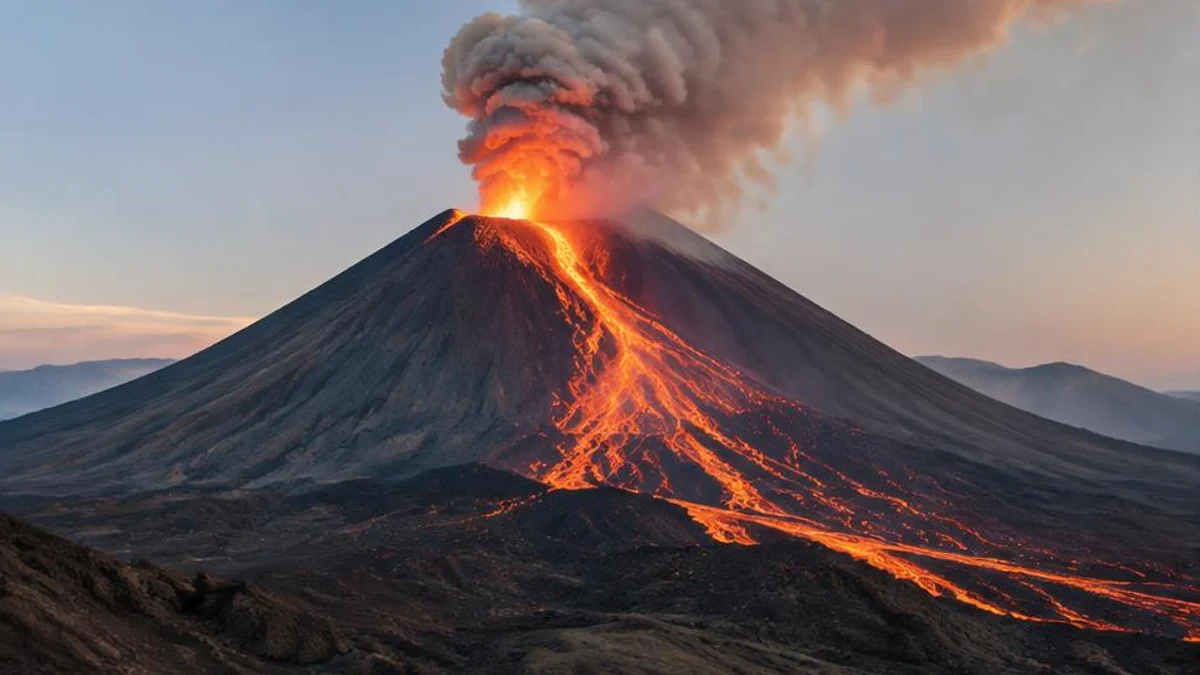
The classic image of a steep cone with a crater is only one kind of volcano. Others include:
- Shield volcanoes, which are broad and gently sloped, built mostly from runny lava flows. Many volcanoes in Hawaii are of this type.
- Fissure eruptions, where magma emerges along long cracks instead of a single vent.
- Calderas, large basin-shaped depressions that can form when a volcano empties its magma chamber and the ground above collapses.
Likewise, eruptions range from effusive (steady lava outpouring) to explosive. Both can be hazardous in different ways, and neither type is "safe" by default.
Where volcanoes occur
Volcanoes are not spread evenly across the globe. Many occur along the edges of tectonic plates, and some are found far from them:
- Subduction zones: where one plate sinks beneath another, water released from the sinking plate helps the overlying rock melt. Many of the world's explosive volcanoes form this way, including those around the Pacific Ocean.
- Divergent boundaries: where plates move apart, magma rises to fill the gap. This happens along mid-ocean ridges, such as the one running through the Atlantic, and in continental rifts.
- Hotspots: areas of unusually hot rock rising from deep in the mantle, which can produce volcanoes in the middle of a plate, as in Hawaii.
Ash is not what comes out of a fireplace
When people hear "volcanic ash," they often think of the soft grey residue of burned wood. They are different things. Wood ash is what is left after burning. Volcanic ash is made of tiny fragments of rock, minerals and volcanic glass produced when magma shatters or rock is blasted apart. The fragments are hard and abrasive, and fine ash can irritate lungs and eyes, damage machinery and make roofs heavy when it settles in thick layers.
Ash belongs to a broader group of materials called tephra, which includes fragments of many sizes thrown into the air during an eruption, from fine ash to larger pieces.
The main hazards
Volcanic hazards vary by volcano and by eruption. Common ones include:
- Pyroclastic currents: fast-moving mixtures of hot gas and volcanic fragments that flow along the ground. They are among the most dangerous volcanic phenomena.
- Lahars: mudflows made of volcanic debris and water. They can travel far down river valleys, sometimes long after an eruption, and may occur when heavy rain or melting snow mixes with loose volcanic material.
- Ash fall: which can affect aviation, water supplies, farming and health over wide areas.
- Lava flows: usually slow enough that people can move away, but destructive to anything in their path.
- Volcanic gases: some can be harmful in concentrated amounts, especially in low-lying areas.
Monitoring and forecasting
Volcano observatories track signs of change using several kinds of data:
- Seismic activity: earthquakes and tremors can signal moving magma or fluids.
- Ground deformation: swelling or tilting of the ground, measured with satellites and instruments.
- Gas emissions: changes in the amount or type of gas released.
Scientists combine this information to judge how likely an eruption is. Forecasts are usually expressed as probabilities and alert levels, not exact times, because volcano behaviour has real uncertainty. That is why official warnings and evacuation orders from local authorities matter more than any individual prediction.
Frequently asked questions
What is the difference between magma and lava?
Magma is molten rock beneath the surface. Lava is molten rock that has erupted onto the surface, and the term also describes the rock formed when it cools.
Why are some eruptions explosive and others not?
It depends mainly on how thick the magma is and how easily gas can escape. Thick magma traps gas, which can cause explosive eruptions. Runny magma lets gas escape more gently.
Is volcanic ash the same as ash from a fire?
No. Volcanic ash is made of tiny fragments of rock, minerals and glass. It is hard and abrasive, unlike the soft residue left by burning wood.
Can scientists predict exactly when a volcano will erupt?
Not to the day. They can recognise warning signs and estimate probabilities, but exact timing remains uncertain.
Are all volcanoes shaped like cones?
No. Some are broad shields, some erupt through long fissures, and some form large collapse basins called calderas.
Sources and further reading
Related reading on FactNest: How earthquakes happen and Why is the sky blue?.

Written by
FactNest Editorial Team
FactNest is operated by Muonix. The FactNest Editorial Team publishes general-interest explainers with AI-assisted drafting and illustrations. Contact contact@muonix.co for questions or corrections; we respond within 2 business days.
More from this author →