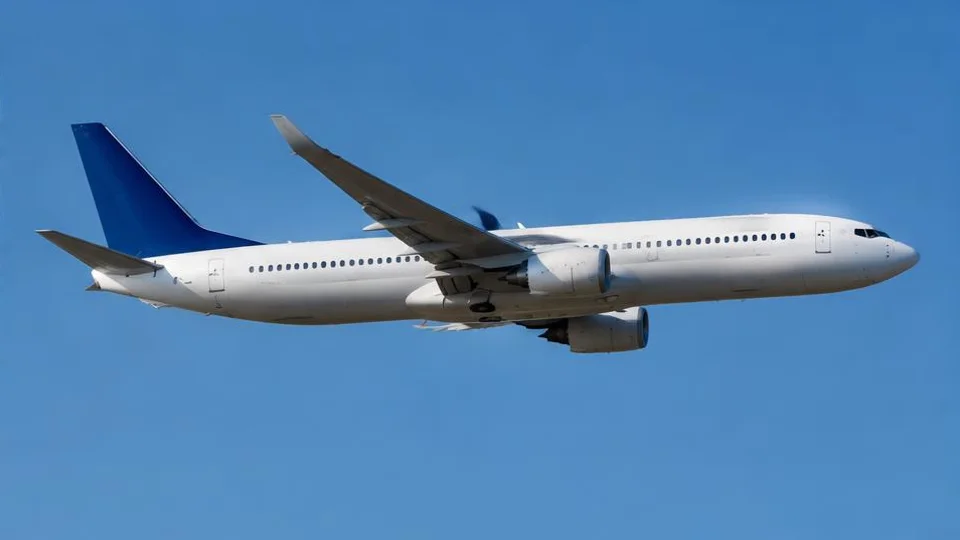
A passenger jet looks too heavy to be supported by something as insubstantial as air. Yet air is matter, and a moving wing creates a pattern of pressure that produces an upward force. The same interaction changes the momentum of the surrounding air. These are connected descriptions of lift, not rival theories. Understanding that connection clears away several stubborn myths—and explains why wing shape matters, why speed helps, and why an aircraft can keep flying even when its engines are not producing thrust.
Key takeaways
- Lift comes from the wing’s pressure distribution and is linked to the downward momentum imparted to air.
- Air passing above and below a wing does not have to reunite at the trailing edge.
- Angle of attack, airspeed, air density and wing area all affect lift; curvature alone does not explain it.
- A stall concerns airflow and angle of attack, not an engine stopping.
A wing changes the air around it
As a wing moves through air, it changes the airflow around itself. Pressure varies over its surface, and those pressures push perpendicular to each small patch of wing. Add these pushes together and a net aerodynamic force emerges. Lift is the component perpendicular to the incoming relative airflow; drag is the component parallel to it, opposing motion through the air.
In ordinary upright flight, pressure is generally lower over much of the upper surface than beneath the wing. Both surfaces contribute. The wing is not simply resting on a cushion of compressed air underneath.
The downward-air connection
The wing also leaves the surrounding airflow with a net downward change in momentum. That requires a force on the air, with an opposite force on the wing. Pressure forces are the physical connection between these descriptions: they act on the wing and accelerate the air. Neither description requires air molecules to bounce off the underside like balls against a board.
Bernoulli and Newton tell compatible stories
Bernoulli’s principle relates pressure and speed along a streamline under appropriate conditions. In the usual simplified picture around a wing, faster airflow corresponds to lower static pressure. Newton’s laws describe the forces required to change the air’s momentum. A consistent account of flight satisfies both.
Bernoulli helps connect the airflow’s speed pattern to its pressure pattern. Newton helps connect forces to the resulting motion of air. Neither, by itself, is a shortcut that explains every detail of the flow. The wing’s shape, orientation and interaction with the surrounding air determine the overall pattern.
Why equal transit time is wrong
A familiar story says air separates at the leading edge, travels farther over the curved top, and must meet its partner at the back. There is no such reunion rule. Air above the wing can reach the trailing edge before air that passed below.
Curvature can influence lift, but a supposed appointment between air parcels cannot explain it.
Angle of attack matters more than a rounded top
Angle of attack is the angle between a wing’s reference line, usually its chord, and the incoming relative airflow. The chord is an imaginary straight line from the leading edge to the trailing edge. This angle is not necessarily the aircraft’s angle above the horizon: the aircraft may be climbing or descending through the air.
Within the normal attached-flow range, increasing angle of attack generally increases lift for a given airspeed. It changes how the wing turns the flow and how pressure is distributed around the surface.
Flat and symmetrical wings can lift
A symmetrical wing can produce lift at a suitable angle of attack, even though its upper and lower shapes match. A flat plate can also produce lift when inclined to the airflow, although it may be less efficient than a purpose-designed wing.
Camber—the curvature of a wing’s cross-section—helps tailor lift and other aerodynamic characteristics. It is useful design geometry, not a prerequisite for flight.
Speed, density and size set the scale
A common lift relationship is written as L = ½ρV²SCₗ. Here, L is lift, ρ is air density, V is airspeed relative to the surrounding air, S is wing reference area, and Cₗ is a lift coefficient describing aerodynamic behaviour. The coefficient depends on factors including wing shape, angle of attack and airflow conditions.
The relationship explains why a larger wing or denser air can provide more lift when the other factors stay unchanged. It also shows why airspeed has a strong effect.
An illustrative comparison
Hypothetical example: suppose a wing’s airspeed doubles while density, wing area and lift coefficient remain unchanged. The relationship predicts four times as much lift. This is a controlled comparison, not a prediction that an actual aircraft suddenly climbs with four times its previous lift: aircraft motion and aerodynamic conditions can change together.
Airspeed is not ground speed. As our explanation of how GPS determines position and movement helps distinguish, movement relative to Earth is a different measurement. Wind can change ground speed without making the same change to airspeed.
Four forces explain powered flight and gliding
The usual forces diagram shows lift, weight, thrust and drag. Weight acts toward Earth. In a typical powered aircraft, engines supply thrust while wings provide most of the lift. Drag resists motion through the air.
In straight, steady, level flight, lift approximately balances weight and thrust approximately balances drag. These are simplified balances: precise force directions and contributions depend on the aircraft and its attitude. Steady flight does not mean forces are absent; it means their combined effect produces no acceleration.
A climb, turn or changing speed requires a different force balance. Lift should therefore not be treated as an upward arrow that always equals weight.
A paper aeroplane needs no engine. The throw gives it initial energy, and in a sustained glide it descends, exchanging gravitational potential energy while drag dissipates energy. Its wings still generate lift. Similarly, losing engine thrust does not instantly remove a powered aircraft’s airflow or lift, although continued flight depends on its circumstances.
Stalls and a safe way to observe airflow effects
A stall occurs when a wing exceeds its critical angle of attack and airflow separation becomes extensive enough to cause a substantial loss of lift. Lift does not necessarily disappear entirely, and drag generally increases. The engine may still be running normally.
Speed matters because maintaining a required lift at lower airspeed commonly requires a higher lift coefficient, often obtained through increased angle of attack. But a stall is fundamentally an angle-of-attack event, not simply crossing a universal speed threshold. This distinction is an explanation of the physics, not flying instruction.
Try a tabletop observation
Hold one end of a light paper strip near your lips, letting the rest droop away from you. Gently blow across its upper surface and observe whether it rises. Keep the paper away from your mouth and clear of other people.
This illustrates airflow interacting with a flexible surface; it is not a complete model of a rigid wing. The paper bends, the jet mixes with surrounding air, and pressure changes influence its motion. Avoid treating the demonstration as proof of equal transit time or of one surface doing all the work.
Frequently asked questions
Can an aircraft fly upside down?
Some aircraft can, provided their design and operating conditions permit it. Inverted flight is another reason rounded-top explanations are insufficient: suitable orientation to the relative airflow can produce lift in the required direction. Wing shape still affects efficiency and performance, and not every aircraft is designed or equipped for inverted operation.
Does suction above the wing really lift it?
“Suction” is useful shorthand for pressure lower than the surrounding reference pressure, not a separate pulling substance. Air pressure pushes on all exposed surfaces. When those pushes are uneven, their combined force can support the aircraft. Lower upper-surface pressure often contributes substantially, but the complete pressure distribution matters.
Why do aircraft need forward motion?
A conventional wing needs motion relative to the air to establish the airflow and pressure distribution that generate lift. Forward flight supplies that motion for typical aeroplanes. Helicopters instead move rotor blades through the air. The essential requirement is relative airflow over lifting surfaces, not movement across the ground itself.
Can I see the air that supports a wing?
Usually not directly. Clouds, condensation or experimental flow markers may reveal aspects of airflow, but they do not show the complete pressure field or measure lift by themselves. Our explanation of why the sky appears blue addresses a separate atmospheric effect: light scattering, rather than the aerodynamic forces supporting an aircraft.
A better picture of a flying wing
Think of a wing as shaping a moving region of air, not merely splitting it into two paths. Pressure differences support the aircraft while forces redirect the air. Keep both views together, and lift becomes understandable without imaginary reunions or a mandatory curved roof.
Sources and further reading

Written by
FactNest Editorial Team
FactNest is operated by Muonix. The FactNest Editorial Team publishes general-interest explainers with AI-assisted drafting and illustrations. Contact contact@muonix.co for questions or corrections; we respond within 2 business days.
More from this author →