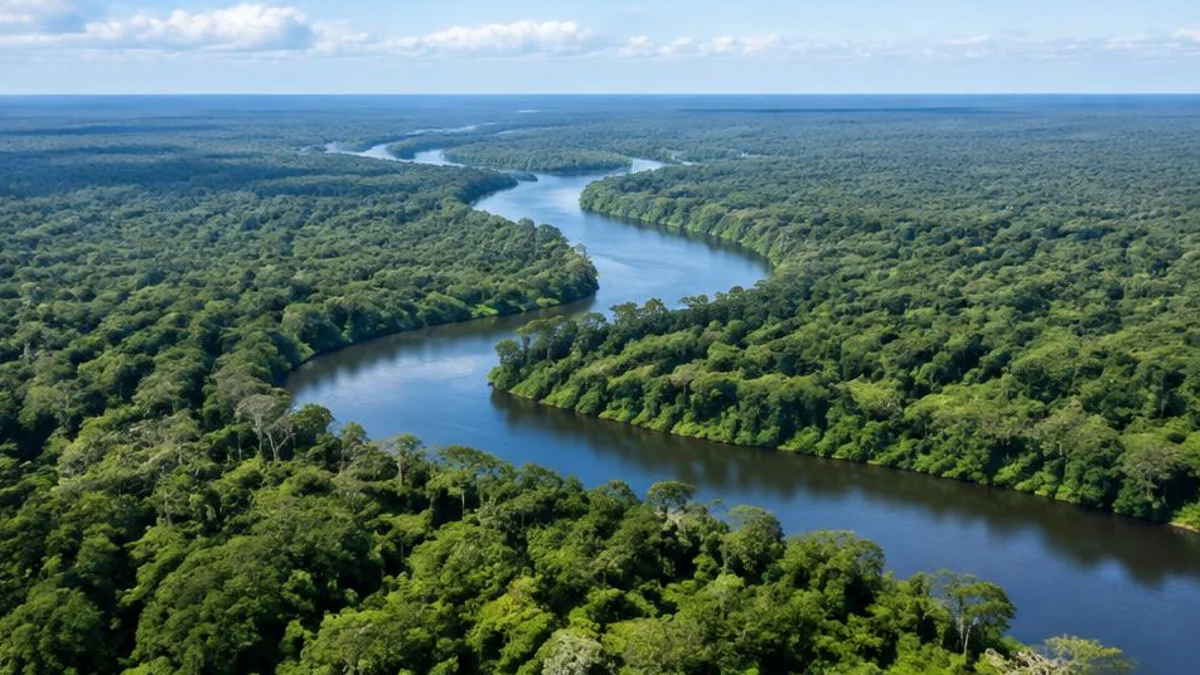
The Great Barrier Reef, off the coast of Queensland in northeastern Australia, is the world's largest coral reef system. It is a vast network of living reefs, islands and channels, and a rich habitat for marine life.
Key takeaways
- The reef stretches roughly 2,300 kilometres along the Queensland coast.
- It consists of thousands of individual reefs and hundreds of islands.
- It supports a huge variety of life, including corals, fish, turtles and whales.
- It was inscribed as a UNESCO World Heritage Site in 1981.
- Repeated marine heatwaves have caused mass coral bleaching.
Size and structure
The Great Barrier Reef is made up of nearly 3,000 separate reefs and around 900 islands, spread over an area of about 344,000 square kilometres. It is not one continuous wall but a patchwork. It is the biggest structure built by living organisms, since corals produce the limestone that forms the reef. Parts of the reef can be seen in satellite images.
Built by tiny animals
Coral polyps, small animals related to sea anemones, build the reef by depositing calcium carbonate skeletons. Over thousands of years, new generations grow on top of old ones. The modern living reef grew on older foundations, with its current form largely developing over the last 8,000 years or so, since sea level stabilised after the last ice age.
Life on the reef
The reef is home to an extraordinary range of species, with estimates including hundreds of types of coral, well over a thousand species of fish, and many molluscs, sharks, rays, sea turtles, sea snakes and seabirds. Humpback whales visit the area to give birth, and dugongs graze on seagrass beds nearby. Six of the world's seven species of marine turtle are found in the region. Many species are found nowhere else.
Protection
The Great Barrier Reef Marine Park, established in 1975, covers most of the reef and is managed by an Australian government authority, which regulates fishing, tourism and shipping through zoning. UNESCO declared it a World Heritage Site in 1981. Indigenous peoples, including Aboriginal and Torres Strait Islander groups, have connections to the reef going back many thousands of years.
Mass bleaching
When ocean temperatures rise above the normal summer range for long enough, corals expel the algae that live in their tissues and give them colour and energy, and they turn white, which is known as bleaching. The reef has experienced several mass bleaching events, including in 1998, 2002, 2016, 2017, 2020, 2022 and 2024, according to monitoring agencies. Corals can recover if conditions improve, but severe or repeated bleaching causes deaths. Scientists link the increasing frequency to ocean warming caused by climate change.
Other threats
Other pressures include runoff of sediment and nutrients from farmland, outbreaks of the crown-of-thorns starfish that eats coral, cyclones and coastal development. Programs aim to improve water quality, control starfish outbreaks and restore coral.
Why it matters
The reef supports local economies through tourism and fishing, protects coasts from waves and is of immense scientific and cultural value. Researchers study it to understand how ecosystems respond to environmental change.
Visiting responsibly
Many visitors snorkel or dive. Choosing operators with good environmental practices, using reef-safe sun protection where recommended, and not touching or standing on coral help protect it.
Zoning and management
The Great Barrier Reef Marine Park is divided into zones with different rules. Some zones, known as green zones, are no-take areas where fishing and collecting are not allowed, to allow marine life to thrive and act as a reserve. Others allow limited fishing or other uses, and general-use zones permit more activities. Roughly a third of the park is protected as no-take. The zoning plan was updated in 2004 to increase protection, and managers also use permits, patrols and education, along with a long-term plan to improve the reef's resilience.
Traditional Owners
The Great Barrier Reef region has been home to Aboriginal and Torres Strait Islander peoples for tens of thousands of years, and more than seventy Traditional Owner groups have connections to the sea country of the reef. They hold deep knowledge of the reef, its seasons and species, and stories that tell of its creation. Traditional Owners are increasingly involved in managing and monitoring the reef, through partnerships, ranger programmes and agreements on how sea country is used.
Wildlife highlights
The reef supports a spectacular range of animals. Raine Island, on the northern reef, is thought to be the largest green turtle nesting site in the world, with tens of thousands of turtles coming ashore to lay eggs. Clownfish live among stinging sea anemones, giant clams can grow over a metre across, and dugongs graze seagrass meadows. In winter, dwarf minke whales visit the northern reef, and humpback whales migrate to the warm waters to breed and give birth. Many species of fish, including parrotfish and wrasses, play roles in keeping the reef healthy.
Monitoring bleaching and recovery
Scientists monitor the reef through aerial surveys, underwater surveys, satellite data and temperature records. The Australian Institute of Marine Science publishes annual summaries of coral cover, which show that coral can recover quickly in some areas after disturbances if conditions allow, but repeated stress reduces recovery. Following the mass bleaching events of 2016 and 2017, large stretches of northern and central reef lost coral, and later years showed partial recovery in some regions, while another bleaching event followed in 2020 and again in 2022 and 2024. The pattern is uneven, and some places are much healthier than others.
Tourism and economy
The reef supports tens of thousands of jobs in tourism, fishing and related industries. Visitors snorkel, dive, fly over the reef and stay on islands, and operators pay a charge that helps fund management. Many tour companies take part in monitoring, reporting changes they see. Responsible visitors can help by choosing operators with good environmental records, staying off the coral and following guidance on wildlife.
Actions to help the reef
As well as limiting global warming, managers focus on factors they can change locally. Programmes work with farmers to reduce fertiliser and sediment runoff, control outbreaks of the crown-of-thorns starfish by injecting them with a harmless solution, and restore damaged areas. Research on cooling and shading techniques, heat-tolerant coral and coral breeding is under way, although experts caution that these cannot replace cutting emissions.
Frequently asked questions
Can the reef be seen from space?
Satellite images show it clearly, but it is not easy to see with the naked eye from orbit.
Is the reef dead?
No. It has suffered significant damage in places, but large areas remain alive, and recovery varies by location.
Is it one reef?
It is a system of thousands of individual reefs.
How big is the Great Barrier Reef compared with countries?
The reef system covers around 344,000 square kilometres, an area bigger than Italy and similar in size to Germany or Japan. It stretches for roughly 2,300 kilometres along the Queensland coast.
When is the best time to visit?
The drier season from about June to October is popular because the weather is cooler and calmer. From roughly November to May, there can be stinging jellyfish and the risk of cyclones, and visitors may wear protective suits. Different seasons suit different activities.
Is the Great Barrier Reef dying?
Parts have suffered severe damage from bleaching, storms and starfish, but the reef is huge and varied, and many areas still have healthy coral. Recovery is possible when conditions allow, but scientists warn that more frequent marine heatwaves threaten its future without strong action on climate change.
Sources and further reading

Written by
FactNest Editorial Team
FactNest is operated by Muonix. The FactNest Editorial Team publishes general-interest explainers with AI-assisted drafting and illustrations. Contact contact@muonix.co for questions or corrections; we respond within 2 business days.
More from this author →