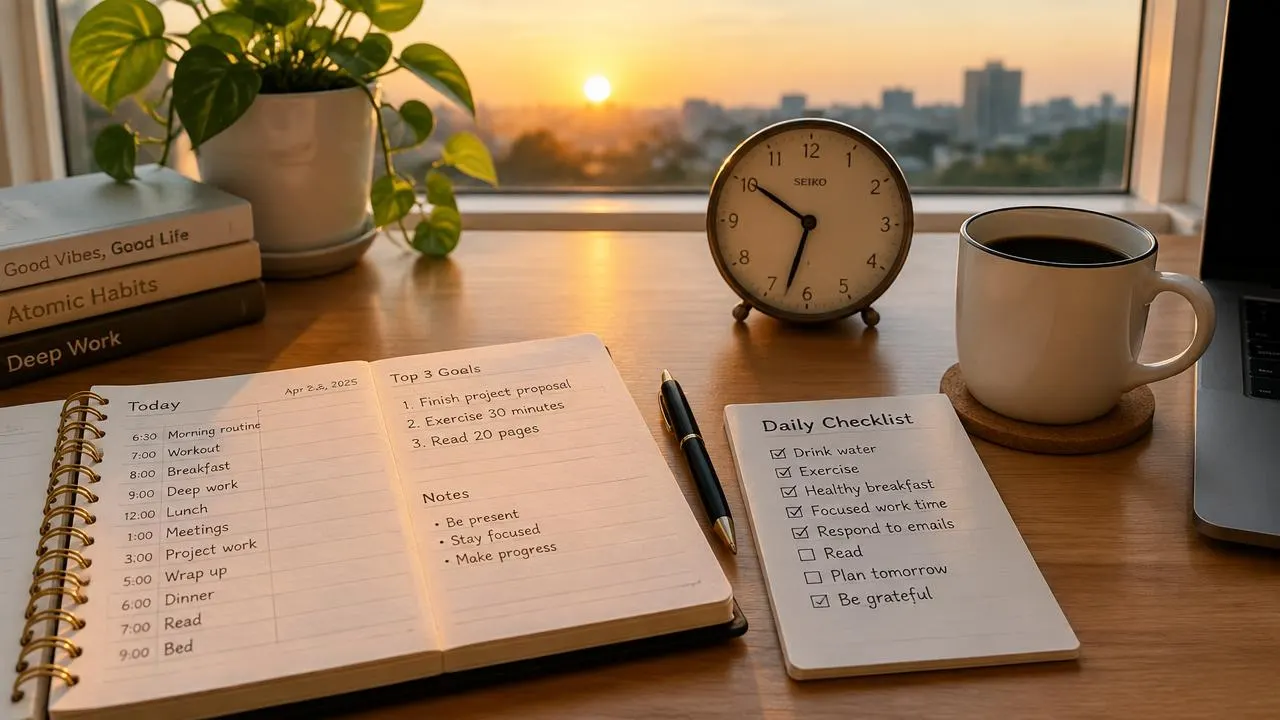
A morning routine is useful only if it works on the mornings you actually have. That might mean getting children ready, coming home from a night shift, managing limited energy, or opening a laptop before the household wakes. Rather than borrowing someone else’s ideal schedule, build a short sequence around your available time and the things that make starting easier. The aim is not to perform a perfect morning. It is to reduce avoidable decisions while leaving room for interruptions, changing needs, and ordinary untidiness.
Key takeaways
- Start with the time and capacity you reliably have, not your best-case morning.
- Attach a small action to a familiar event, such as finishing breakfast or arriving at your desk.
- Prepare the specific things that tend to delay you; preparation should remove work, not create another elaborate routine.
- Keep a minimum version and review what happens during a realistic week.
Start with your actual morning constraints
Before choosing activities, identify your morning’s fixed points. When must you leave, begin paid work, respond to someone else’s needs, or be available for a call? Work backwards from those commitments, allowing for essential personal care, meals where relevant, travel, and transitions.
The time left is your routine’s budget. Treat it as a limit, not a challenge to squeeze harder. Available capacity matters too: a free interval may not be usable if you need rest, assistance, or time to manage an unpredictable household.
Separate essentials from optional additions
List what must happen and what would merely be pleasant. Preparing a child’s bag may be essential; reading before departure may be optional. Neither category measures personal worth.
Choose an addition only after the essentials fit. For a broader look at organising tasks beyond the morning, see practical ways to improve your daily productivity. A morning routine cannot compensate for an overloaded day.
Give a small action a dependable cue
“Have a better morning” is an intention, not an instruction. A usable action has a clear starting point and an obvious finish: after putting your breakfast dish away, check the day’s first commitment. After opening your work bag, confirm that the item you need is inside.
The cue matters because it gives the action a place in an existing sequence. You are not repeatedly deciding when to remember it. The action’s small size makes it easier to fit into that place without displacing something necessary.
Use events when clock times are unreliable
An event-based cue can suit changing shifts or caregiving better than a fixed hour. “After my main sleep” may be more meaningful than “before sunrise.” Choose something that happens reliably in your own circumstances.
Habit-building guidance from the University of Mary Washington provides useful background, but no fixed completion deadline is necessary here. Practise, notice friction, and adjust; do not judge the routine against a promised transformation date.
Prepare the bottleneck, not the whole day
Evening preparation is most useful when it targets a recurring obstacle. If you search for your keys, establish an accessible place for them. If choosing clothes delays you, set out suitable options. If you start work unsure where to begin, leave a plain-language note naming the next task.
This works by moving a decision or search away from a pressured moment. It does not make the task disappear, so consider whether the evening genuinely offers more capacity. Someone caring for a relative overnight may be better served by preparing during an afternoon pause.
Keep arrangements safe and practical for your home. Shared spaces, mobility needs, children, and pets can affect where items belong.
Avoid preparing for every possibility. If the preparation becomes harder than the problem it solves, simplify it. A useful test is specific: “What did I have to find, decide, or redo yesterday that I could make easier next time?”
Try a routine that fits a real departure window
The following is an illustrative example, not a researched formula. Imagine someone who has about fifteen discretionary minutes after essential care and breakfast, before leaving home. Their aim is to leave ready and know where the working day begins.
| Hypothetical time | Action | Purpose |
|---|---|---|
| First three minutes | Check the calendar and any essential travel update | Confirm what affects departure |
| Next four minutes | Gather the bag and items already prepared | Avoid a last-minute search |
| Next three minutes | Write the first manageable work action | Reduce uncertainty at arrival |
| Final five minutes | Leave unallocated | Absorb a delay without rushing the whole sequence |
The buffer is part of the design, not unused space waiting for another habit. If gathering belongings regularly takes longer, the routine needs revision rather than faster execution.
Someone working at home might replace the bag check with setting up an accessible workspace. Someone providing care might use the final interval for a handover. Keep the function; change the activity.
Build a minimum version that respects sleep and capacity
A flexible routine needs a deliberate fallback. Decide what remains when time, attention, or energy is scarce. That might be checking the next commitment and gathering the essential item for it. Other additions can wait.
A minimum version prevents a missed optional activity from turning into abandonment of the whole plan. It should not be a compressed version of everything. Remove tasks rather than expecting yourself to perform them faster.
Do not fund the routine by cutting sleep
CDC guidance includes keeping consistent sleep and wake times. Follow that principle where practical, without treating a rigid schedule as feasible for every shift worker, carer, or disabled person. There is no universal early waking hour that makes a routine worthwhile.
If you are curious about the distinction between sleep itself and experiences during it, our article on why we dream and what sleep science explores offers related reading. A routine is an organisational tool, not treatment for sleep difficulties.
Observe a week before adding more
Use a week as a practical observation period, not a deadline for habit formation. After each attempt, record briefly what happened: the cue you noticed, the action you completed, and the point where the sequence became difficult. Keep recording light enough that it does not become the main task.
Watch for repeated obstacles rather than judging individual mornings. Was the cue missing? Were the materials elsewhere? Did a caring responsibility take priority? Different problems need different changes.
Illustrative one-week review: In the sample routine, the person repeatedly opens messages during the calendar check and loses the departure buffer. They change the step to checking only the calendar and necessary travel information, leaving other messages until later. On a disrupted morning, they use the minimum version.
That observation suggests a specific adjustment; it does not prove a general rule about phones. Change the part causing friction, then observe again. Add activities only when there is a clear purpose and room for them.
Frequently asked questions
What if I do not control when my morning starts?
Build around an event you can recognise rather than an hour you cannot guarantee. For a shift worker, this could be finishing the first meal after waking. For a carer, it might be the end of a handover. Keep the action small and allow a backup cue when the usual sequence is interrupted.
Should exercise, journaling, or meditation be included?
Only if the activity serves a purpose you value and fits your circumstances. None is an entry requirement for a useful routine. Consider access, enjoyment, setup time, and what the activity would replace. Start with the problem you want to solve rather than assembling a checklist of activities associated with an ideal morning.
What should I do after missing several mornings?
Resume at the next suitable cue without trying to catch up on optional activities. Then examine why the routine disappeared. A temporary disruption may require no redesign, while repeated difficulty may indicate an unrealistic time budget or inaccessible setup. Return to the minimum version if that makes restarting simpler and more practical.
How can I tell whether the routine is helping?
Look for changes connected to your original aim: fewer searches for belongings, a clearer first task, or fewer avoidable departure decisions. Notice costs too, including extra preparation or pressure. Your observations cannot establish broad health effects, but they can help you decide whether this particular arrangement is worth keeping or changing.
Make tomorrow’s start easier
Choose a recurring morning difficulty and a small action that addresses it. Give that action a cue, prepare what it needs, and decide what survives an interruption. The routine earns its place by helping you start your real day—not by resembling anyone else’s.
Sources and further reading

Written by
FactNest Editorial Team
FactNest is operated by Muonix. The FactNest Editorial Team publishes general-interest explainers with AI-assisted drafting and illustrations. Contact contact@muonix.co for questions or corrections; we respond within 2 business days.
More from this author →