A resume has a simple job: to help someone decide, in a short time, whether you are worth talking to. Employers often skim, so a resume that is clear, specific and honest has a better chance than one that is long, vague or stuffed with buzzwords. The good news is that writing a strong resume is mostly a matter of choosing the right evidence and presenting it plainly. You do not need fancy design or secret tricks, and nobody can guarantee a job or a particular score from automated screening.
This guide draws on general advice from university career services, including Harvard's, which reflects norms common in the United States. Conventions vary by country, industry and employer, so always follow any instructions in the job posting and check local expectations.
Key takeaways
- Start with what the role needs, then choose the experience, skills and projects that show you can do it.
- Write bullet points that start with an action verb and describe what you did and what resulted.
- Use specific facts and real numbers only where they are true. Never invent or inflate details.
- Keep the layout simple, consistent and easy to skim, with clear headings.
- Tailor each resume to the role, using the employer's own wording where it genuinely fits.
- Conventions about photos, personal details and length differ by country and industry, so check what applies.
- If you are early in your career, volunteering, projects and learning count as evidence, too.
- No format guarantees an interview, and no one can promise a score from an applicant tracking system.
Step 1: read the role before you write
Before choosing what to include, read the job posting and note:
- The main responsibilities of the role.
- The skills and qualities the employer asks for.
- Any instructions about how to apply, such as file type, length or required documents.
Then ask yourself which of your experiences best match. A resume is not a full life story. It is a selection of your most relevant evidence, which is why the same person might send different versions to different employers.
Step 2: choose a clear structure
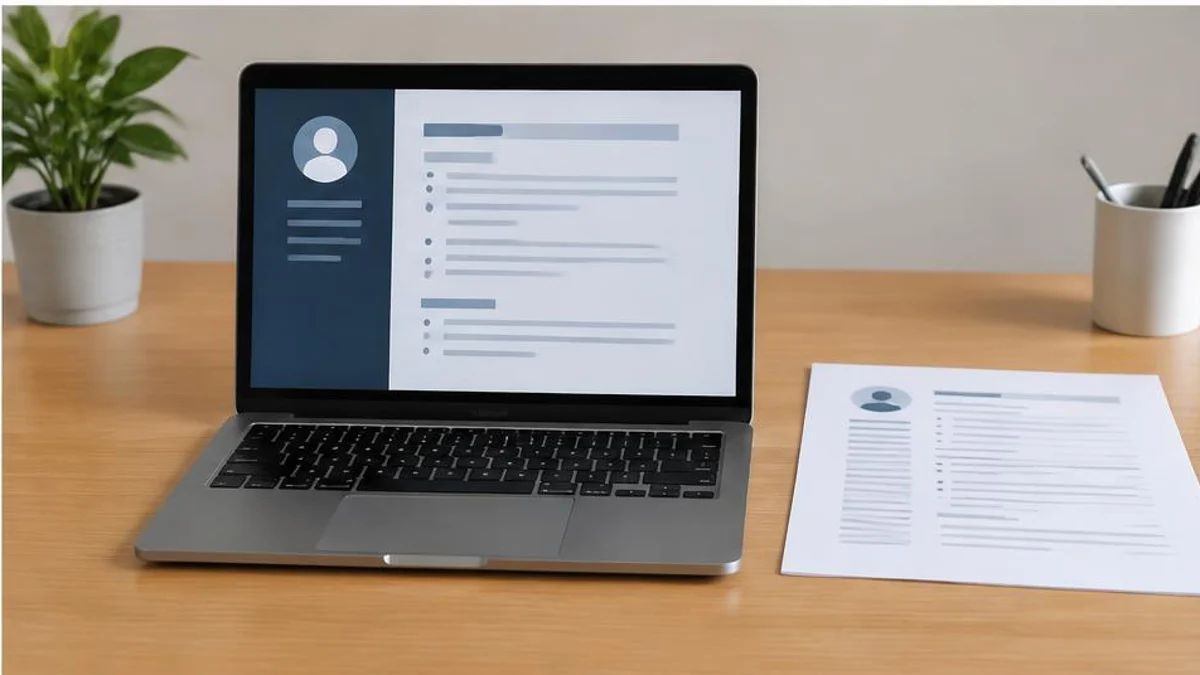
Most resumes use plain headings and a reverse-chronological order within each section, meaning the most recent item comes first. Common sections include:
- Contact details at the top: your name, email and phone number, and a link to a professional profile or portfolio if relevant. Missing contact information is a surprisingly common mistake.
- Experience: paid jobs, internships and other work, in order of relevance and date.
- Education: schools, degrees and relevant training.
- Projects, volunteering or leadership: useful evidence, especially early in a career.
- Skills: a short, honest list of tools, languages or abilities you can actually demonstrate.
Put the sections that best support your case first. For a recent graduate, that may be education and projects. For someone with several years of experience, it is usually work history.
Step 3: write bullet points that show evidence
Bullet points are where most resumes are won or lost. Strong ones usually share a few features:
- They begin with an action verb, such as "organised," "built," "reduced" or "taught," chosen to fit the work.
- They are specific: what you did, for whom, with what tools, and with what outcome.
- They include numbers where you honestly have them, such as the size of a team, a time saved or a number of customers, and leave numbers out where you do not.
- They use plain, active language, without long narrative or flowery phrases.
A fictional before-and-after example
This example is made up to illustrate the idea. The names and numbers are not real and are not a template to copy.
Before: "Responsible for helping with customer emails and various tasks in the office."
After: "Answered an average of [number] customer emails a day for a team of [number], using a shared inbox and a set of standard replies, and updated the replies after noticing recurring questions."
The second version says what was done, how, and what changed. If you do not know exact numbers, describe the situation honestly instead of guessing: "Answered customer emails daily and created a list of common questions that the team added to its standard replies."
The bracketed items show where you would put your own real information. If a figure is not true, leave it out.
Step 4: be honest, always
It can be tempting to stretch the truth, but a resume should accurately represent you. Avoid:
- False claims about jobs, degrees, certificates or skills.
- Inflated titles or responsibilities that do not match what you did.
- Invented metrics. If you cannot back up a number, do not use it.
- Unexplained gaps or dates that do not add up. Dates should be consistent, and gaps can be explained briefly where it helps.
Employers often check details, and discrepancies can end an application at any stage, including after you are hired.
Step 5: keep the design simple and readable
A clean layout helps a person skimming your resume and also helps software that reads it:
- Use a clear, standard font and a readable size.
- Use consistent formatting for headings, dates, bold and italics.
- Leave white space so the page does not look crowded.
- Use simple section headings such as Experience and Education, instead of creative labels.
- Save in the file format the employer requests, and check that it looks right when opened on another device or exported as a PDF.
- Think about accessibility: plain text structure and good contrast make a document easier for everyone to read.
Heavy graphics, columns, icons and text boxes can sometimes confuse automated systems, so simpler is usually safer.
Step 6: tailor, without stuffing
Tailoring means highlighting the parts of your background that matter most for this role. It is reasonable to use words from the job description when they honestly describe what you have done. For example, if the posting asks for "scheduling" and you coordinated schedules, say so in those terms.
Keyword stuffing is a different matter: packing in words you cannot back up, or hiding extra terms, does not help and can backfire when a person reads your resume or interviews you. Be wary of anyone who promises a guaranteed score from an applicant tracking system. Systems differ, and no one can guarantee how a particular employer's software or recruiter will respond.
Conventions differ
What is normal on a resume varies:
- Photos, date of birth, marital status and similar personal details are expected in some countries and discouraged or even inappropriate in others. For example, US university career services typically advise against photos and personal details such as age.
- Length: a single page is a common expectation for early-career applicants in some settings, while others accept longer documents. If a posting states a limit, follow it.
- Terminology: "resume" and "CV" are used differently in different regions.
When in doubt, follow the employer's instructions and look at examples from your own country and field.
If you are just starting out
A short work history is not a barrier. You can show evidence through:
- Volunteering, clubs, community work or caring responsibilities.
- Projects, such as something you built, organised, wrote or researched.
- Courses and self-directed learning, with dates and what you produced.
- Part-time and informal work, described in terms of the responsibility you handled.
The point is to show that you can do the things the role needs, in the most honest and specific way available.
A short checklist before you send it
- Does the resume match this particular role?
- Does every bullet start with a verb and show a specific result or fact?
- Is every claim and number true and something I can discuss?
- Are my contact details correct and easy to find?
- Is the layout simple, consistent and easy to skim?
- Are dates consistent, and are gaps explained where useful?
- Have I followed the employer's instructions for format and length?
- Has someone else proofread it?
You can also read our guide to taking better notes for ways to collect your achievements as they happen, and how to write a clear email, which pairs well with a short cover message.
Frequently asked questions
How long should a resume be?
There is no universal rule. Many early-career applicants in some countries use one page, but expectations vary, so follow the employer's instructions.
Should I include a photo?
It depends on the country and industry. Some places expect one and others advise against it. Check local conventions and the job posting.
Should I use the same resume for every job?
No. Tailor it to each role, highlighting the experience and skills that best match, while keeping everything truthful.
Can I add numbers if I am not sure of them?
Only use numbers you can support. If you do not have exact figures, describe what you did honestly without inventing statistics.
Can anyone guarantee that my resume will pass automated screening?
No. Systems differ, and nobody can guarantee a score or a result. Clear structure, honest content and relevant wording are the sensible approach.
Sources and further reading
- Create a strong resume (Harvard FAS Mignone Center for Career Success)
- HES: create impactful resumes and cover letters (Harvard FAS Mignone Center for Career Success)
Related reading on FactNest: How to write a clear email that is easy to answer and How to take better notes you can actually use.

Written by
FactNest Editorial Team
FactNest is operated by Muonix. The FactNest Editorial Team publishes general-interest explainers with AI-assisted drafting and illustrations. Contact contact@muonix.co for questions or corrections; we respond within 2 business days.
More from this author →