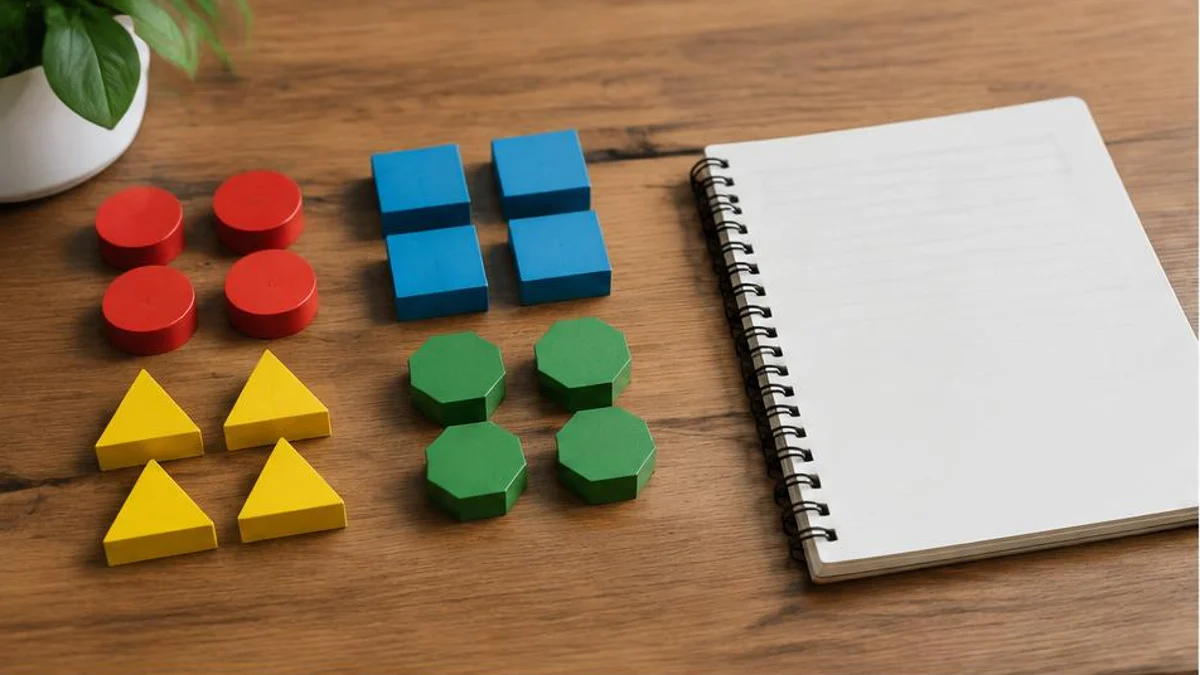
Mnemonics are memory aids that help you remember information by linking it to something easier to recall: a word, a picture, a place or a rhyme. People have used them since ancient times, and they remain useful for lists, sequences and facts.
Key takeaways
- Mnemonics turn hard-to-remember information into memorable patterns.
- Common types include acronyms, rhymes, imagery and the method of loci.
- Vivid, unusual or personal images work best.
- Mnemonics help with facts and lists, but understanding is still needed.
- Combine them with spaced review for long-term memory.
Why they work
Memory tends to be better for information that is meaningful, vivid and well organised. Mnemonics add structure and meaning to otherwise arbitrary material, giving you a retrieval cue. They work with strengths of the brain, such as visual and spatial memory.
Acronyms and acrostics
An acronym uses the first letters of items to form a word, such as ROY G. BIV for the colours of the rainbow: red, orange, yellow, green, blue, indigo, violet. An acrostic makes a sentence from first letters, like "Every Good Boy Deserves Fruit" for the lines of the treble clef in music: E, G, B, D, F. Creating your own is often more memorable than using someone else's.
Rhymes and songs
Rhymes and tunes help because rhythm and sound are easy to recall. "Thirty days hath September, April, June and November" helps with month lengths. Many children learn the alphabet through a song.
Visual imagery and association
Link a new item to a vivid image. To remember the name "Carpenter," imagine a person sawing wood. Exaggerated, humorous or emotional images stick better. For learning vocabulary in another language, the keyword method links the sound of a foreign word to a similar-sounding English word and creates an image combining the two.
The method of loci (memory palace)
This is an ancient technique, attributed in classical stories to the poet Simonides. You imagine a familiar place, such as your home, and mentally place items you want to remember at distinct locations along a route. To recall them, you "walk" through the place and see each item. It works well for ordered lists, speeches and sequences, and memory competitors use it.
The peg system
You memorise a fixed list of "pegs," such as rhymes for numbers: one is bun, two is shoe, three is tree. To remember a list, you link each item to its peg through an image, such as a bun filled with the first item. It helps with numbered lists.
Chunking
Grouping information into smaller meaningful chunks, as we do with phone numbers, makes it easier to hold in memory. Breaking a long string of numbers into groups of three or four is a simple example.
When mnemonics help most
They are great for arbitrary information such as lists, terminology, vocabulary and sequences. For deep understanding, such as why a historical event happened, you also need to engage with concepts and reasoning. Use mnemonics as a starting point and then practise recalling the information regularly.
Tips
- Make your images vivid, unusual and personal.
- Use as many senses as possible.
- Practise retrieving the information soon after learning, and again at increasing intervals.
- Keep it simple, since a very complex mnemonic can be harder to remember than the original.
Building a memory palace step by step
The method of loci works best when you set it up carefully. Choose a place you know very well, such as your home or your daily walk to work. Decide on a fixed route and pick eight to ten distinct spots along it, called loci, for example the front door, the hall mirror, the kitchen table. Always walk the route in the same order. Now take the items you want to remember and turn each into a vivid image, then place one image at each locus. Make the images unusual, large, moving or funny, because bizarre pictures are easier to recall. To recall the list, mentally walk the route and look at each spot. After a day or two, repeat the walk to strengthen the memory.
The link and peg methods
The link method joins items in a chain of images or a short story. For a shopping list of bread, eggs and soap, you might imagine a giant loaf cracking open to reveal eggs that slide onto a bar of soap. The peg method uses a fixed set of peg words, such as rhyming words for numbers, onto which you hook new items. Both methods work because they turn abstract items into pictures and connect them in a structure.
Names and numbers
People often complain about forgetting names. A helpful approach is to pay attention when you hear the name, repeat it aloud, and link it to something in the person's appearance or to a vivid image. For example, you might picture someone called Rose holding a rose. For numbers, chunking helps: break a long phone number into groups of three or four digits. Memory competitors use systems that convert digits into sounds and then into words, but these take practice.
When mnemonics do not help
Mnemonics are tools for storing arbitrary information, not for understanding. A memory palace will not help you grasp why a chemical reaction happens or how to solve an equation. They also take effort to set up, so they suit information you need to keep for a while rather than a one-off fact. Combining mnemonics with testing yourself over time gives better results than relying on the images alone.
Memory athletes
The World Memory Championships features competitors who memorise decks of cards, long numbers and names within minutes using techniques such as the method of loci. Researchers who studied these athletes found that their brains were not unusual, but they had trained hard with mnemonic strategies. This supports the idea that memory is a trainable skill, though extreme competition feats are not needed in daily life.
Frequently asked questions
Do mnemonics really work?
Research on memory techniques, including the method of loci and keyword method, generally shows benefits for remembering lists and vocabulary.
Is a memory palace hard to use?
It takes a little practice, but many people find it enjoyable.
Can I use mnemonics in exams?
Yes. They can help you recall lists and formulas, though you still need understanding to apply them.
Do memory palaces work for exams?
They can help with ordered lists, key terms and sequences, such as the stages of a process. They are less helpful for understanding concepts, so it is best to combine them with practice questions and explaining ideas in your own words.
How many items can I store?
The number depends on how many loci you have and how well you practise. Beginners often start with ten items and add more places as they improve. Many people use several palaces for different subjects.
Are mnemonics only for lists?
They are most useful for lists and sequences, but you can also use images and stories to remember facts, vocabulary and the order of steps. Any information that can be turned into a picture or a pattern can be given a mnemonic.
Sources and further reading

Written by
FactNest Editorial Team
FactNest is operated by Muonix. The FactNest Editorial Team publishes general-interest explainers with AI-assisted drafting and illustrations. Contact contact@muonix.co for questions or corrections; we respond within 2 business days.
More from this author →